

Palermo is the capital of Sicily and one of the island’s most historically layered cities. Arab and Norman architecture, Baroque churches, monumental palaces, traditional markets and grand theatres coexist within an extensive historic centre shaped by centuries of different cultures and rulers.
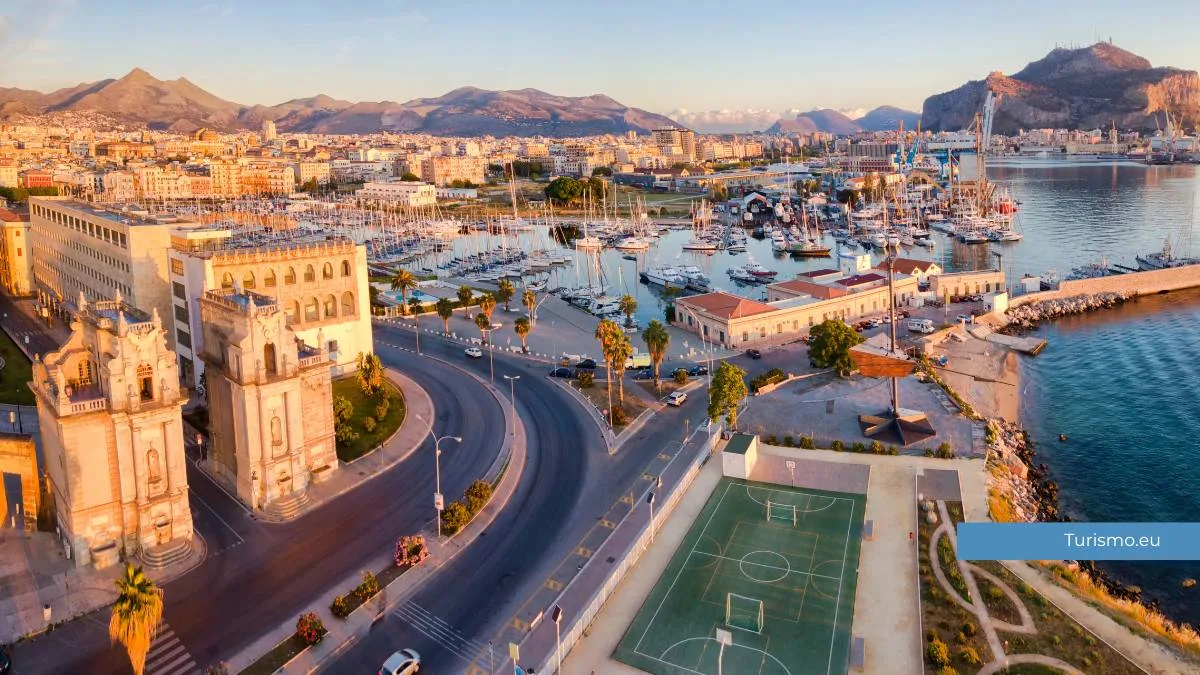
The city stands on a wide gulf at the foot of Monte Pellegrino. The surrounding plain is known as the Conca d’Oro and was famous for centuries for its citrus groves.
It is worth spending at least a few days in Palermo, exploring the centre on foot and alternating visits to monuments and squares with walks through the markets and stops to sample the local food.
What to see in Palermo
Teatro Massimo and Piazza Verdi
Piazza Verdi is dominated by the Teatro Massimo, opened at the end of the nineteenth century and one of the largest opera houses in Europe.
Via Maqueda begins nearby and forms one of the main thoroughfares through the historic centre, connecting several of Palermo’s best-known sights.
Quattro Canti and Piazza Pretoria
At the intersection of Via Maqueda and Corso Vittorio Emanuele stands Quattro Canti, an octagonal square framed by four Baroque façades. It marks the symbolic meeting point of Palermo’s historic districts.
A short walk away, Piazza Pretoria is occupied by a large sixteenth-century fountain. The square is also known as Piazza della Vergogna, or Square of Shame, a name traditionally associated with the nudity of its statues.
The surrounding streets contain numerous churches, historic buildings and small squares that can easily be explored on foot.
La Martorana and San Cataldo
Piazza Bellini contains two buildings that reflect the cultural complexity of medieval Palermo.
The Church of Santa Maria dell’Ammiraglio, commonly known as La Martorana, preserves remarkable Byzantine mosaics. Beside it, the Church of San Cataldo is immediately recognisable by its three red domes.
Both churches form part of Palermo’s Arab-Norman heritage and illustrate the meeting of Byzantine, Islamic and Western traditions that characterised Norman Sicily.
Palermo Cathedral
Palermo Cathedral stands along Corso Vittorio Emanuele. Its present appearance combines architectural elements from different periods, reflecting the many alterations made over the centuries.
Inside are the tombs of several Norman and Swabian rulers, including Emperor Frederick II.
The Norman Palace and Palatine Chapel
The Norman Palace was once the royal residence and now houses the Sicilian Regional Assembly.
Its most important space is the Palatine Chapel, decorated with golden mosaics and combining Byzantine, Islamic and Western artistic elements. It is one of the clearest examples of the cultural exchange that took place in Norman Sicily.
The palace and chapel deserve a separate visit rather than being treated as a quick stop during a walk through the centre.
Palermo’s historic markets
The markets are an important part of Palermo’s urban landscape and everyday life.
Ballarò is the largest and busiest. Its stalls sell fruit, vegetables, fish, spices and foods connected to different culinary traditions. The market is deeply rooted in the Albergheria district and still serves a practical daily function.
Vucciria, made famous by Renato Guttuso’s painting, has changed considerably over time. Today the area combines market activity with restaurants, bars and evening entertainment.
Capo develops through a network of narrow streets filled with food shops and stalls. Its position makes it easy to include while visiting the northern part of the historic centre.
Visiting more than one market helps reveal different sides of Palermo. They should not be viewed only as tourist attractions but as neighbourhoods that continue to change throughout the day.
What to eat in Palermo
Palermo’s food reflects the many cultures that have influenced the city. Some of its best-known specialities can be eaten in markets, bakeries and informal street-food shops.
Arancine are filled rice balls, usually fried and prepared with different fillings. Panelle are chickpea fritters often served in bread, sometimes together with potato croquettes.
Sfincione is a soft, thick local bread topped with tomato, onion, anchovies and cheese.
More unusual specialities include pani câ meusa, a sandwich filled with spleen, and stigghiole, grilled offal traditionally sold as street food.
Among the pasta dishes, pasta con le sarde combines sardines, wild fennel, raisins and pine nuts.
Where to stay in Palermo
For a first visit, the historic centre is usually the most practical area. It allows many monuments, markets and restaurants to be reached on foot and offers a wide choice of hotels, bed and breakfasts and apartments.
Via Maqueda, Quattro Canti and the Kalsa district are convenient for exploring the older parts of the city.
The area around Politeama and Via Libertà has a more modern and commercial atmosphere while remaining within reasonable distance of the main sights.
Visiting Monreale from Palermo
Monreale lies a few kilometres outside Palermo and can be visited as a half-day or full-day trip.
Its cathedral is known for its extensive golden mosaics, while the adjoining cloister contains decorated columns and finely carved capitals.
Palermo, Monreale and Cefalù share a group of monuments included in the UNESCO site known as Arab-Norman Palermo and the Cathedral Churches of Cefalù and Monreale.
How long to spend in Palermo
With only one day, it is necessary to select a small number of monuments and concentrate on the historic centre.
Two or three days allow time to visit the main buildings, walk through the markets and explore different neighbourhoods at a more comfortable pace.
With additional time, the itinerary can include Monreale, Monte Pellegrino or the coast around Mondello.