

Overlooking the Ionian Sea and dominated by the outline of Mount Etna, Catania is one of the principal cities of eastern Sicily. The presence of the volcano is visible throughout the city: in the dark stone used for its buildings, in the history of its eruptions and in the contrast with the Baroque façades reconstructed after the earthquake of 1693.
Most of the main sights are concentrated within the historic centre, which can easily be explored on foot. A walk through Catania leads from monumental squares to traditional markets, Baroque churches and remains from the Roman and medieval periods. The city is also a practical base for visiting Mount Etna and the Ionian coast.
What to see in Catania
Piazza del Duomo and the Cathedral of Sant’Agata
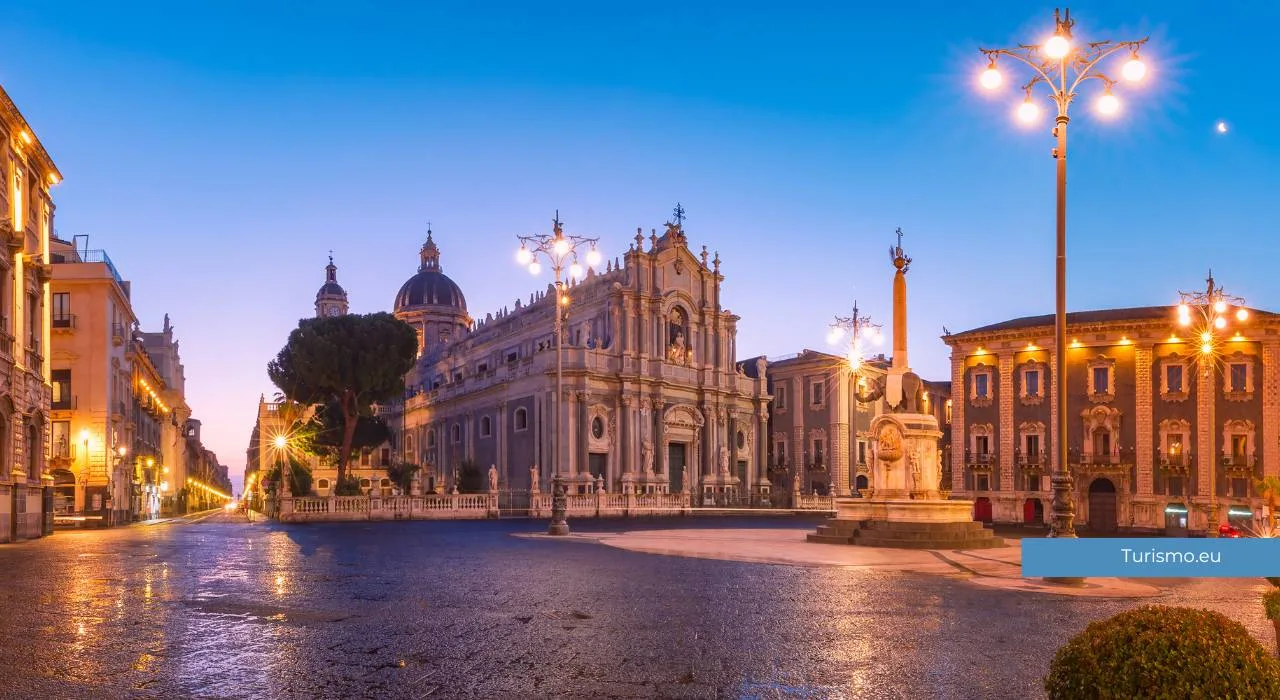
Piazza del Duomo is the monumental heart of the city. At its centre stands the Fountain of the Elephant, featuring the Liotru, the lava-stone elephant that has become the symbol of Catania.
The Cathedral of Sant’Agata, dedicated to the city’s patron saint, overlooks the square. Its present appearance is largely the result of the reconstruction that followed the earthquake of 1693, which profoundly changed Catania and much of south-eastern Sicily.
The cathedral also contains the tomb of Vincenzo Bellini, who was born in Catania in 1801.
La Pescheria
Behind Piazza del Duomo is La Pescheria, Catania’s historic fish market. It is one of the places where the city’s everyday life is most visible, among stalls selling fish, fruit and vegetables and the small businesses surrounding the market.
The best time to visit is during the morning, when trading is at its busiest. The surrounding streets also contain trattorias and other places serving traditional Catanian dishes.
Via Etnea and Piazza Università
Via Etnea, one of the main streets through central Catania, begins at Piazza del Duomo. It crosses several important squares and, on clear days, offers views of Mount Etna to the north.
Along the route is Piazza Università, surrounded by Baroque palaces. A little further ahead, Piazza Stesicoro contains part of the remains of the ancient Roman amphitheatre.
Via Crociferi and Catanian Baroque
Within a few hundred metres, Via Crociferi brings together churches, former convents and palaces built mainly after the earthquake of 1693.
It is one of the best places to observe Catania’s Baroque architecture and the distinctive contrast between dark lava stone and the pale limestone used for decoration.
Benedictine Monastery
The Benedictine Monastery of San Nicolò l’Arena is one of Catania’s most important monumental complexes.
Its history is closely connected with the transformations of the city. It was affected by the eruption of 1669 and later by the earthquake of 1693. Subsequent reconstruction and expansion created a complex containing several distinct architectural phases.
Part of the monastery is now occupied by the University of Catania.
Teatro Massimo Bellini
Dedicated to the Catanian composer, the Teatro Massimo Bellini opened in 1890 with a performance of Norma.
The auditorium is richly decorated, and its ceiling contains scenes inspired by Bellini’s operas. Even without attending a performance, Piazza Vincenzo Bellini is worth including in a walk through the city centre.
Ursino Castle
Built in the 13th century for Frederick II of Swabia, Ursino Castle is one of Catania’s principal surviving medieval buildings.
It originally stood close to the sea. The eruption of Mount Etna in 1669 altered the coastline and the surrounding terrain, gradually leaving the castle further inland.
The building now houses the Civic Museum.
Bellini Garden
Located along Via Etnea, Bellini Garden is one of the principal green spaces in central Catania. Its tree-lined paths, flower beds and terraces provide a useful place to rest while exploring the city.
Catania’s markets
In addition to La Pescheria, Catania has another important historic market: Fera ’o Luni, held around Piazza Carlo Alberto.
It is larger and less closely connected with tourism, selling food, clothing and everyday goods. La Pescheria and Fera ’o Luni therefore reveal two different aspects of the city’s commercial life.
Catania and Mount Etna
It is difficult to separate Catania from Mount Etna. The volcano dominates the landscape north of the city and has influenced its territory, architecture and urban development for centuries.
Lava flows have reached Catania several times, and volcanic stone has become one of the characteristic materials used in its buildings and streets.
Excursions to the volcano can be organised from the city, but Mount Etna should not be treated merely as a brief addition to a visit to Catania. The volcanic area is extensive and deserves a separate day.
What to eat in Catania
One of the dishes most closely associated with the city is pasta alla Norma, made with tomato, fried aubergines and salted ricotta. According to tradition, its name is a reference to Vincenzo Bellini’s opera Norma.
Arancini are another essential part of the local cuisine, together with cartocciate, cipolline and other products typically sold in Catania’s rosticcerie.
Granita served with brioche is particularly common at breakfast, with flavours changing throughout the year.
Catania as a base for eastern Sicily
The city’s position provides access to several parts of the Ionian coast. To the north lie Aci Castello and Aci Trezza, followed by Taormina and the coast towards Messina. Travelling south leads towards Syracuse and south-eastern Sicily.
Catania can therefore work both as an urban destination and as a base for a longer journey combining cities, coast and volcanic landscapes.
Getting to and around Catania
Catania–Fontanarossa Airport is located only a few kilometres from the centre and is one of the principal gateways to Sicily.
A car is not essential for visiting the historic centre, as many of the main sights lie within walking distance of one another. If Catania is being used as a base for visiting Mount Etna, the coast or other parts of eastern Sicily, however, having a car provides greater flexibility.