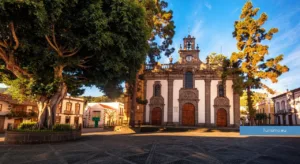
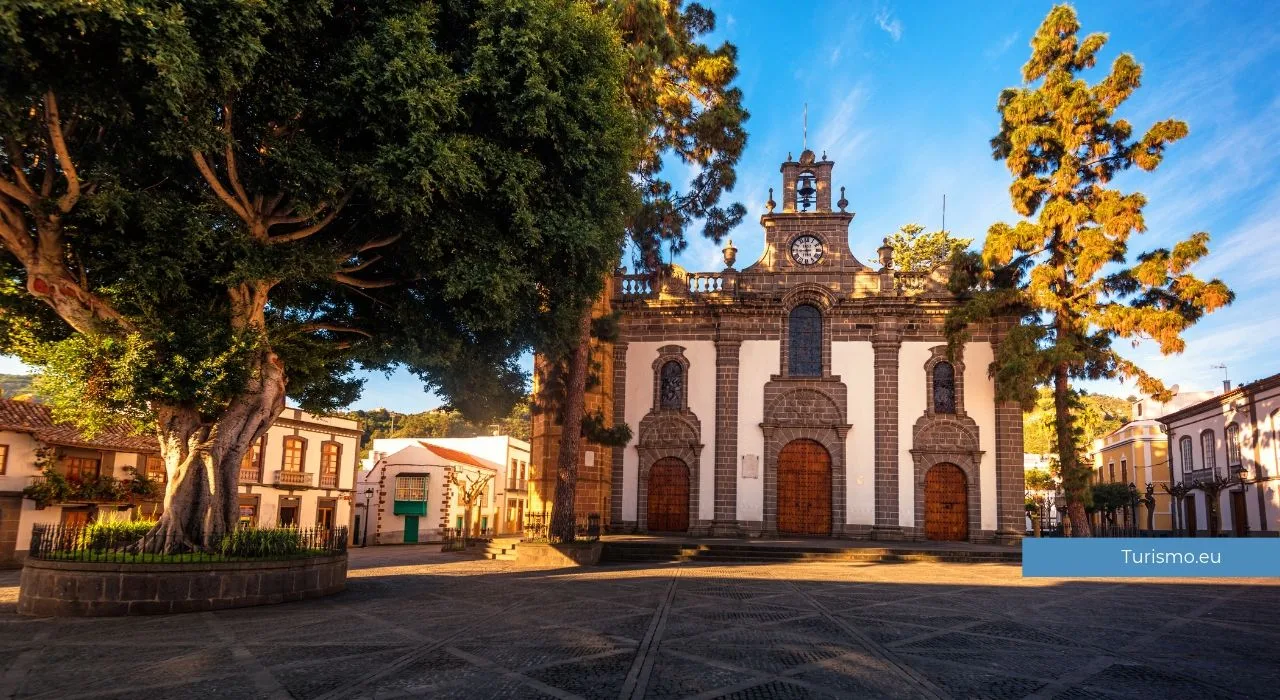
In Teror, wooden balconies project over the streets of the centre, colourful houses line the route towards the basilica, and market stalls fill the spaces around the church on Sundays. The town lies in the hills of northern Gran Canaria, at around 600 metres above sea level, in a landscape quite different from the dry surroundings of the southern beach resorts.
The compact centre is best explored on foot. Teror is an interesting stop for its traditional Canarian architecture and the island’s connection with the Virgen del Pino, as well as a place to spend a few hours browsing the market and sampling local produce.
Teror’s historic centre
You can begin your walk along Calle Real de la Plaza, the street leading towards the basilica. Some of the town’s most distinctive façades stand here, with wooden balconies, doorways and details worth noticing as you explore.
The balconies are Teror’s most recognisable feature. They vary in size and craftsmanship, lending a sense of continuity to buildings from different periods. Take time to look at the houses and side streets rather than heading straight for the church.
The historic quarter is small enough to explore without a fixed itinerary. Calle Real and the basilica square are its main landmarks.
Plaza del Pino is the heart of the historic centre, surrounded by traditional buildings.
Teror’s Sunday market
On Sundays, the centre takes on a different appearance. The Mercadillo de Teror takes place around the basilica and in Plaza de Sintes, attracting residents and visitors.
Stalls sell bread, cheese, sweets, cured meats, crafts and other goods. The market has a long history, connected both to trade and to the town’s religious role.
The opening hours listed by the local council are 9 am to 3 pm on Sundays. Check for any changes before planning your day.
The Fiesta del Pino
Teror’s connection with the Virgen del Pino becomes particularly evident during the September celebrations, whose main day is 8 September.
The town welcomes pilgrims and people attending religious events and community festivities. It is an opportunity to experience an important island tradition, although the atmosphere is very different from an ordinary visit to the historic centre.
If you are travelling during this period, plan your journey carefully and check the programme and traffic arrangements. Choose other dates if you prefer a less crowded walk around town.
Finca de Osorio, near Teror
Around two kilometres from the historic centre lies Finca de Osorio, an estate encompassing woodland, farmland, rural buildings and walking paths.
It offers an opportunity to combine a visit to the town with a walk in green surroundings. Trails of varying lengths and gradients explore a landscape where farming and woodland exist side by side.
Allow more than a quick stop: it is worth setting aside part of the day to explore at a leisurely pace. The ground can be damp, so suitable walking shoes are recommended.
Access to Finca de Osorio requires a permit, under the arrangements established by the Cabildo de Gran Canaria. Before adding it to your itinerary, check availability and apply for permission.
Nearby: Valleseco and La Laguna
From Teror, you can continue towards Valleseco, around seven kilometres away, along a road climbing between green slopes, scattered houses and cultivated land. Stop at the Mirador de la Vuelta de los Pájaros to look down over Teror and see how the town sits among the surrounding mountains and ravines.
The Valleseco area retains a rural landscape of small plots, orchards and wooded slopes. Apple growing is a distinctive feature, supporting local cider production and baking. The appeal of this excursion extends beyond the village centre to the countryside and damp landscapes of Gran Canaria’s northern interior.
One of the most interesting stops is La Laguna de Valleseco, a volcanic basin within Doramas Rural Park. Here you can walk among trees and vegetation associated with laurel forest, stopping beside the pond to watch birds. Despite its name, do not expect a large lake: the main attraction is the natural setting and the opportunity to explore it on foot.
Teror and La Laguna work well together as a day trip, with the morning in the historic centre and the afternoon in the countryside. Bring shoes suitable for damp ground and a light jacket, particularly when clouds settle over the hills.
San José del Álamo recreation area
Another option for rounding off your visit is the Zona Recreativa de San José del Álamo. Set among pine trees, it has picnic tables, fixed barbecues, water, toilets, parking and children’s play equipment.
It is particularly suitable if you want to bring a picnic and spend a few hours outdoors. You can combine it with a walk around the historic centre, bringing everything you need for lunch.
Before visiting, check opening hours and any restrictions: the presence of barbecues does not mean fires are always permitted, particularly during periods of increased wildfire risk.