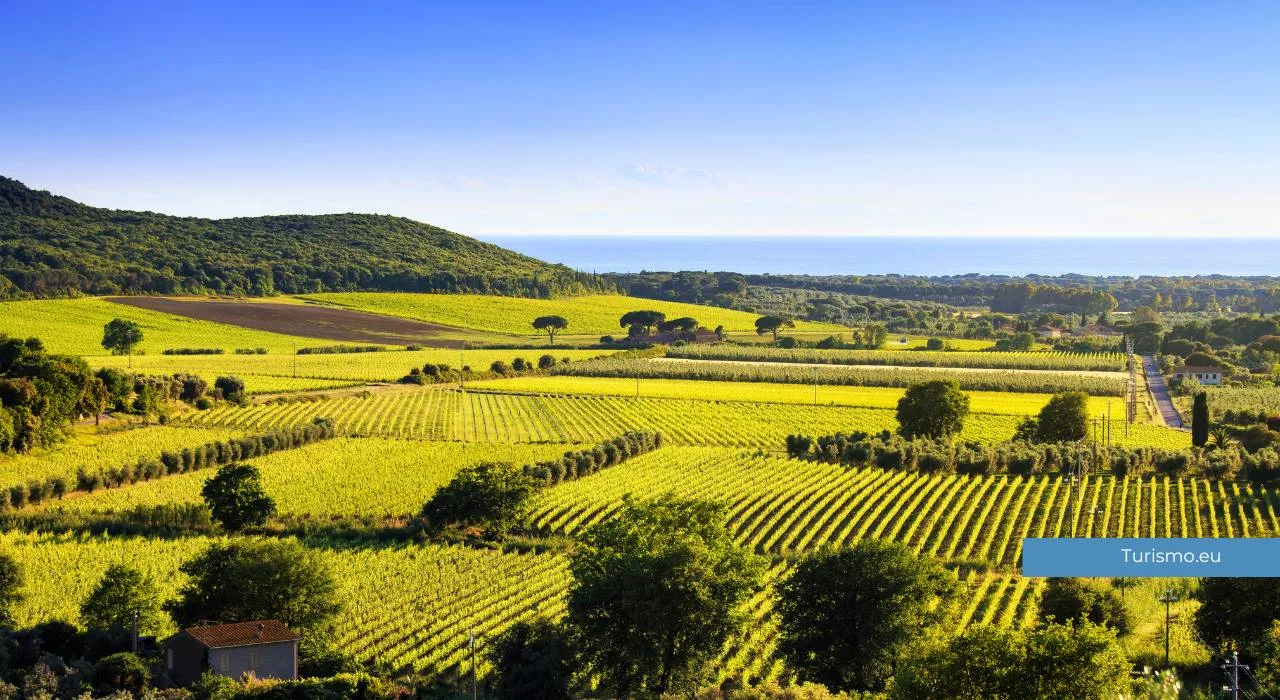


The Maremma covers a large area of southern Tuscany, where the Tyrrhenian coast meets pine forests, wetlands, cultivated hills and towns built on tuff rock.
There is no single centre from which to explore the entire region. Castiglione della Pescaia and Monte Argentario are mainly associated with the coast; Alberese and Talamone provide access to the Maremma Regional Park; Pitigliano, Sovana and Sorano introduce an inland landscape of ravines, woodland and rock walls.
Distances are manageable, but the secondary roads and variety of landscapes make it better to organise the journey by area.
Maremma Regional Park
Maremma Regional Park protects a section of coastline between Principina a Mare, Alberese and Talamone. Its landscape includes pine forests, wetlands, pastures, hills and largely undeveloped beaches.
Alberese is one of the principal access points. Walking and cycling routes lead from here towards the coast, the watchtowers and the Monti dell’Uccellina hills.
The trails vary in length and difficulty. Some are suitable for a short walk, while others take several hours and cross areas with little shade.
Access, internal transport and visiting arrangements may change according to the season and wildfire risk. Current trail conditions should therefore be checked before setting out.
Marina di Alberese
Marina di Alberese is the park’s best-known beach. It is reached by crossing a long pine forest and offers a setting very different from that of an organised seaside resort.
The beach is broad, with dunes, driftwood and Mediterranean vegetation. Facilities are limited, and vehicle access may be regulated during summer.
Wildlife and the absence of large tourist facilities are part of the area’s character. Food and waste should not be left behind, and visitors must follow the park’s regulations.
Talamone
Talamone occupies a headland at the southern end of Maremma Regional Park. The small town extends below its fortress and overlooks the gulf.
The surrounding coast is partly rocky and exposed to the wind. The area is therefore also popular for sailing, windsurfing and kitesurfing.
Talamone can be combined with a day in the park or used as a base for reaching Alberese, Orbetello and Monte Argentario.
Castiglione della Pescaia
Castiglione della Pescaia combines a seaside resort along the coast with a historic centre gathered on the hillside.
From the upper town, the view extends across the harbour, beaches and coastal plain. Restaurants, shops and services are concentrated along the seafront and around the port.
Beaches stretch both north and south of the town and include organised sections as well as free public areas. In July and August, traffic and parking can become difficult, particularly during the middle of the day.
The town is a practical base for travellers who want to spend part of their holiday by the sea while remaining within reach of Maremma Regional Park, Grosseto and the northern coast.
Punta Ala and Cala Violina
North of Castiglione della Pescaia are Punta Ala and the Scarlino coastline.
Punta Ala is a residential resort developed around a marina and surrounded by pine forests and headlands. Continuing north leads to the Bandite di Scarlino Nature Reserve.
Within the reserve lies Cala Violina, a small beach reached on foot or by bicycle along trails through the Mediterranean scrub.
During summer, visitor numbers are limited and advance booking may be required. Cala Violina should not therefore be treated as an unplanned stop: access rules, parking arrangements and availability need to be checked beforehand.
Orbetello and its lagoon
Orbetello stands in the middle of the lagoon separating the Monte Argentario headland from the mainland.
The landscape is characterised by shallow water, canals and areas visited by numerous bird species. Part of the lagoon is protected and can be explored according to the routes and visiting arrangements established by the nature reserve.
Two sandy strips connect Monte Argentario to the coast: Feniglia to the south and Giannella to the north. Both have long beaches, pine forests and level paths.
Feniglia is also suitable for walking and cycling. In summer, the areas closest to the entrances can become busy, while the landscape grows less developed further along the strip.
Monte Argentario
Monte Argentario is connected to the mainland through Orbetello and the two sandy strips of Feniglia and Giannella.
Its principal towns are Porto Santo Stefano and Porto Ercole. Porto Santo Stefano is the main harbour and the departure point for ferries to Giglio and Giannutri. Porto Ercole is smaller and extends between its harbour, historic quarter and the fortifications overlooking the coast.
The panoramic road around Monte Argentario crosses headlands and areas with broad sea views, but some sections may be narrow, uneven or unsuitable for certain vehicles. Current road conditions should be checked before attempting the entire route.
Small beaches and rocky coves are scattered around the headland. Many involve a descent on foot and have very limited parking, so it is better to choose one or two rather than attempt to cover the whole coast in a single day.
Capalbio and the Tarot Garden
Capalbio stands on a hill a short distance from the southern coast. Its centre is enclosed by walls and offers views across the countryside towards the sea.
Nearby is the Tarot Garden, an art park created by Niki de Saint Phalle and composed of large sculptures covered with mirrors and colourful ceramics.
Opening periods and admission arrangements should be checked in advance. The garden can be combined with Capalbio, but it requires enough time and should not be fitted hurriedly between a beach visit and Monte Argentario.
Pitigliano
Pitigliano rises on a tuff outcrop surrounded by valleys and steep rock walls.
Its centre is crossed by narrow streets, arches and passages that follow the shape of the plateau. Part of its history is connected with the Jewish community that lived in the town for centuries.
Viewpoints along the approach road reveal the full profile of the settlement. It is worth allowing several hours to explore the streets rather than stopping only for the view from outside the town.
Sovana, Sorano and the Vie Cave
Sovana and Sorano complete the area known as the tuff towns.
Sovana is a small settlement built along a main street and surrounded by archaeological sites. Sorano has a more complex layout, with buildings arranged along the slopes and passageways cut into the rock.
The surrounding area contains the Vie Cave, ancient paths deeply carved into the tuff. Their tall walls create shaded and humid environments even during warm weather.
The routes vary in length and difficulty. They can become slippery after rain, so suitable footwear and a check of trail conditions are necessary.
Saturnia and Manciano
Saturnia is best known for its thermal water and the Cascate del Mulino, where warm water flows through natural travertine pools.
Its popularity brings large numbers of visitors at weekends and during holiday periods. Those including it in a Maremma journey should arrive early in the morning or travel outside high season.
Manciano, Montemerano and other small inland towns lie nearby. Saturnia can be combined with one of these places, but adding the Monte Argentario coast on the same day would make the schedule unnecessarily demanding.
Magliano in Toscana
Magliano is a walled town surrounded by olive groves and cultivated fields.
Nearby are the Olivo della Strega, a large olive tree with an unusual shape, and the remains of San Bruzio Abbey. These places require less time than the tuff towns and can be included while travelling between Alberese, Talamone and the interior.
Magliano also offers an alternative to the coastal resorts for travellers who prefer to stay in the countryside and have access to a car.
Grosseto as a base
Grosseto occupies a central position in relation to the coast and Maremma Regional Park.
Its historic centre is enclosed by walls and can be explored in a few hours. The city’s main advantage, however, is practical: it provides more services, transport connections and accommodation than the smaller towns.
It is well placed for reaching Castiglione della Pescaia, Alberese and Marina di Grosseto, but is less convenient for Pitigliano, Saturnia and the southernmost part of the Maremma.
How many days to spend in the Maremma
Three days are enough to concentrate on one area, such as Maremma Regional Park with Talamone and Castiglione della Pescaia, or Monte Argentario with Orbetello and Capalbio.
With five days, the coast and the tuff towns can be combined, although this may require a change of base or some longer journeys.
A week allows time for beaches, nature trails, thermal springs and inland towns without fitting too many places into each day.
The Maremma is not suited to a journey built around a rapid succession of stops. Its variety makes it better to select a few areas and give each one enough time.
When to visit
Spring and early autumn are the best periods for walking in the parks, visiting the towns and travelling through the interior.
June and September generally make it possible to combine sightseeing with time by the sea while avoiding some of the summer crowds.
July and August are mainly suited to a beach holiday, but the best-known beaches, car parks and resorts around Monte Argentario can become very busy.
In winter, the coast is quiet and the towns retain essential services, although some tourism businesses operate reduced hours or remain closed.