

Siena follows the contours of its hills: streets descend into old valleys, climb between brick buildings and suddenly open onto views of the Tuscan countryside.
Piazza del Campo and the cathedral are its best-known landmarks, but the city is better understood by exploring its side streets, recognising the symbols of the contrade and observing the constant transition between built-up areas and green spaces.
The centre is easily explored on foot, although visitors should be prepared for steep streets and numerous steps.
Piazza del Campo
Piazza del Campo is the heart of Siena. Its shell-like shape follows the natural slope of the ground and converges towards the Palazzo Pubblico.
The Palazzo Pubblico and Torre del Mangia stand at the lower end, while the Fonte Gaia occupies the opposite side. The square is surrounded by brick buildings that give it a remarkably consistent appearance.
Early in the morning, it is easier to appreciate the structure of the square. In the evening, it becomes one of the city’s main gathering places.
Palazzo Pubblico and Torre del Mangia
The Palazzo Pubblico still houses Siena’s town hall. Part of the building is open to visitors and contains some of the city’s most significant historic rooms.
Beside the palace stands the Torre del Mangia. From the top, the view extends over Piazza del Campo, the rooftops of the centre and the surrounding countryside.
The climb involves numerous steps and narrow passages. Those who prefer not to climb the tower can find other, less demanding viewpoints around the historic centre.
Siena Cathedral
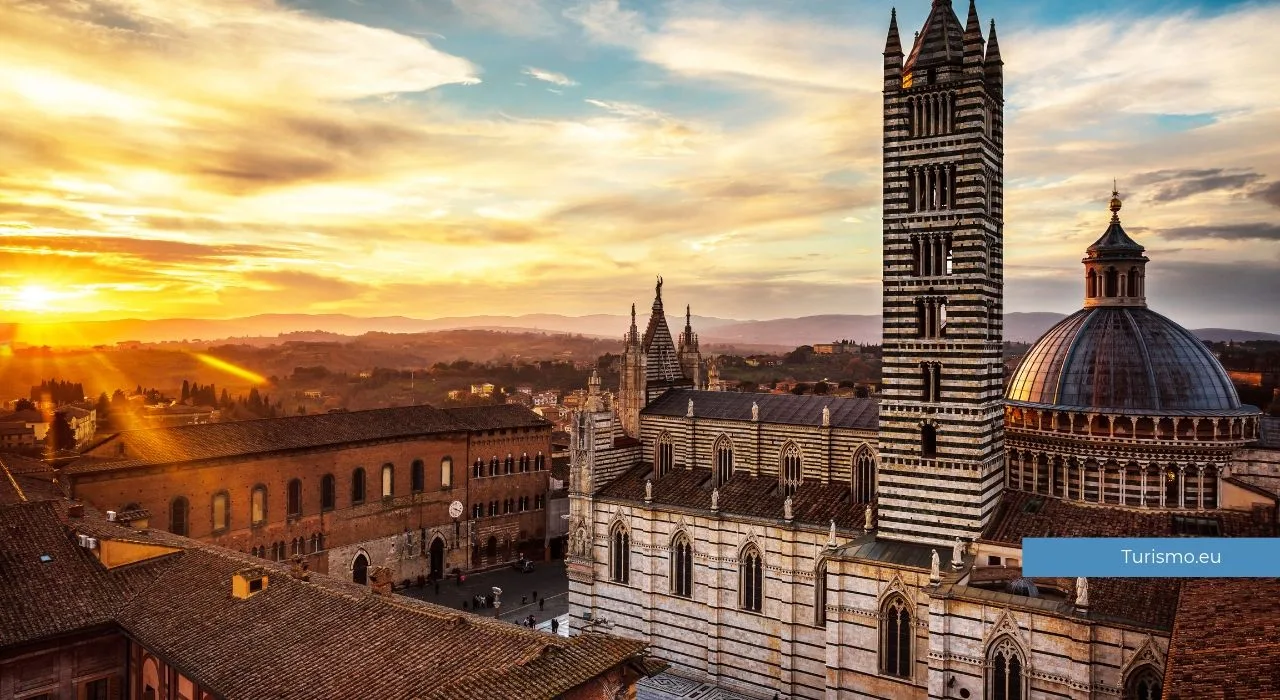
Siena Cathedral stands in the upper part of the city and is distinguished by its white and dark marble façade and interior.
Inside are striped columns, decorated chapels and a floor composed of marble inlays and engraved scenes. The entire floor is not always visible, as some sections are protected for part of the year.
Beside the cathedral are the large remains of a medieval extension that was never completed. Part of the structure, known as the Facciatone, provides elevated views over central Siena, although access is regulated and queues may form during busy periods.
Opposite the cathedral stands Santa Maria della Scala. The complex is extensive and requires a separate visit. With only one day in Siena, it is better to choose between this and the other main monuments.
The streets of the historic centre
Via di Città connects Piazza del Campo with the cathedral area. Banchi di Sopra leads towards Piazza Salimbeni and Porta Camollia, while Banchi di Sotto continues towards Porta Romana.
These are the busiest streets, lined with shops, restaurants and historic buildings. To understand the layout of Siena more clearly, however, it is worth turning into the smaller side streets.
Here, steps, arches between buildings and views across the valleys reveal how the city was adapted to its uneven terrain. Distances are short, but the hills can make journeys take longer than they appear on a map.
Siena’s contrade
Siena is divided into seventeen contrade, each with its own name, emblem, colours and community spaces.
Flags, plaques, symbols and fountains encountered around the centre indicate the transition from one contrada to another. The boundaries are not always obvious to first-time visitors, but they continue to have a precise meaning for the people who live in the city.
The contrade remain part of Siena’s life throughout the year. Recognising their symbols and territories helps visitors see Siena as a collection of communities rather than simply a monumental historic centre.
San Domenico and Fontebranda
The Basilica of San Domenico stands on the western edge of the centre. From the surrounding area, the cathedral can be seen rising on the opposite hill, creating one of Siena’s most recognisable views.
Descending into the valley leads to Fontebranda, one of the city’s medieval fountains. This route passes through a quieter part of Siena but includes some fairly steep descents and climbs.
From Fontebranda, visitors can return towards Piazza del Campo or follow the streets climbing towards the cathedral.
Orto de’ Pecci
A short distance from Piazza del Campo, Orto de’ Pecci occupies a green valley within the city walls.
From its paths, the Torre del Mangia and the buildings of central Siena can be seen beyond vegetable gardens and fields. The landscape feels almost rural despite its proximity to the busiest streets.
It is a pleasant place to pause and observe Siena from a different perspective.
The Medici Fortress
The Medici Fortress is located near the Basilica of San Domenico. Its bastions and outer paths are now used for walking, running and viewing the city from a more open setting.
It is not an essential stop during a short visit but can be included by travellers spending more than one day in Siena.
Places to visit near Siena
Siena’s location provides access to several areas of central Tuscany, but it is better to choose one direction for each day trip.
To the north are Monteriggioni, with its small centre enclosed by walls, and the landscapes of Chianti. San Gimignano lies in the same general direction but deserves a separate visit.
South-east of Siena are the Crete Senesi, known for their clay hills, cultivated fields and panoramic roads. Asciano and Monte Oliveto Maggiore Abbey are two possible stops for exploring this area.
Further south lies the Val d’Orcia, including Pienza, Montalcino and Bagno Vignoni. The distances and country roads make it unrealistic to combine Siena and the Val d’Orcia properly in a single day.
A car is generally the most practical option for exploring the surrounding countryside. Siena can therefore serve as a useful base for alternating days in the city with excursions to nearby towns and rural areas.
How long to spend in Siena
One day is enough to visit Piazza del Campo, the cathedral and the principal streets of the centre. It is advisable, however, to limit the number of ticketed attractions. Visiting the Palazzo Pubblico, Torre del Mangia, the cathedral complex and Santa Maria della Scala on the same day would make the schedule too demanding.
With two days, there is time to include Fontebranda, Orto de’ Pecci, the fortress and a more extensive walk through the contrade.
Siena can also be used as a base for visiting Monteriggioni, Chianti and the northern part of the Val d’Orcia.
Getting there and parking
Much of Siena’s historic centre is covered by a restricted traffic zone. Visitors arriving by car should park outside the walls and continue on foot, by escalator or on a local bus.
The best car park depends on the part of the centre being visited and the location of the accommodation. It is worth choosing one before setting out rather than following a satnav into the narrow central streets.
The railway station lies outside the centre at a lower elevation. Buses and a system of escalators connect it with the upper part of the city.
Intercity buses generally arrive closer to the historic centre and can be a practical option for travellers coming from Florence.
Where to stay
Staying within the walls makes it possible to walk to Piazza del Campo, the cathedral and the restaurants in the centre. Before booking, visitors should check for steps and the distance from the nearest car park or bus stop.
Accommodation outside the walls is often more convenient for those travelling by car and planning to use Siena as a base for exploring the countryside.
When to visit Siena
Spring and early autumn are generally the most comfortable seasons for exploring Siena on foot.
In summer, the heat can make the steep streets tiring during the middle of the day. Winter is quieter, although daylight hours are shorter.
Whatever the season, a visit should not be limited to Piazza del Campo. Siena’s sloping streets, contrade and green valleys are essential parts of the city’s character.