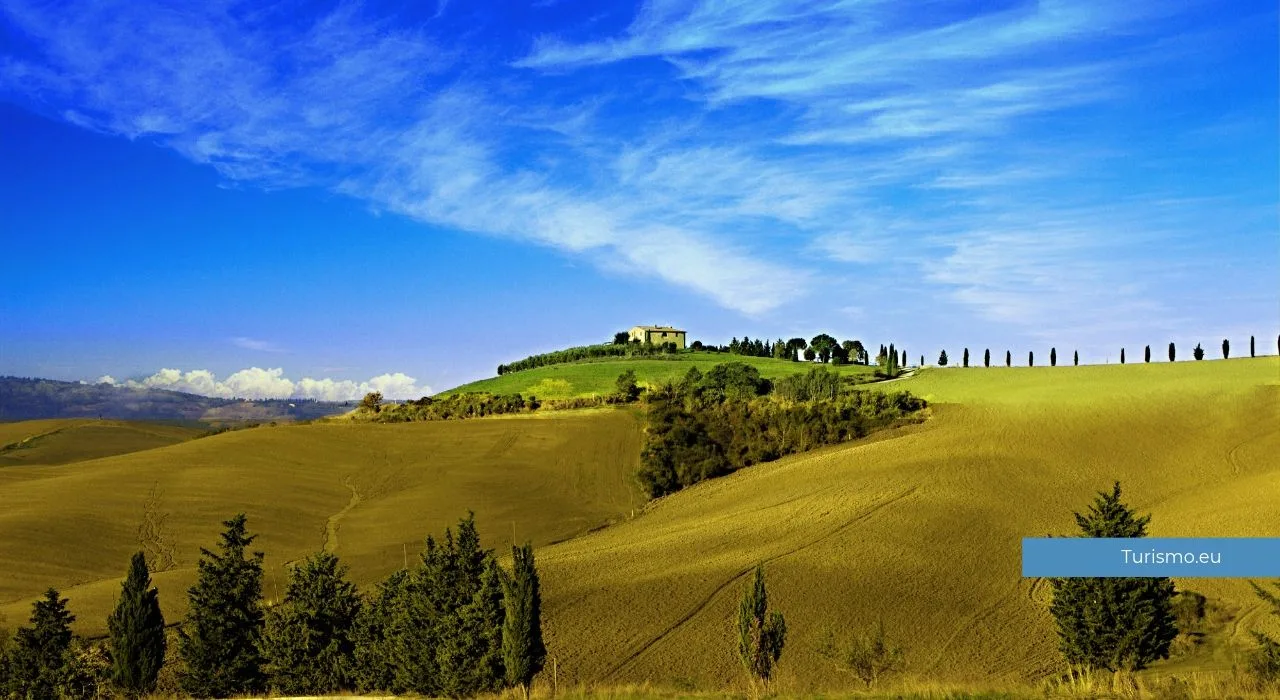


In southern Tuscany, between Siena and Monte Amiata, Val d’Orcia is one of the region’s most recognisable landscapes. Gently rolling hills, country roads lined with cypress trees, isolated farmhouses and small medieval villages create scenery that has inspired painters, photographers and travellers for centuries.
But Val d’Orcia is much more than a picture-perfect landscape. It is a region deeply connected to Tuscany’s agricultural history, crossed by ancient routes and dotted with villages that preserve important examples of medieval and Renaissance architecture.
Since 2004, the cultural landscape of Val d’Orcia has been recognised as a UNESCO World Heritage Site, acknowledging the historical and artistic value of a territory shaped by the interaction between people and nature.
Exploring this part of Tuscany means discovering a remarkable variety of places: from the Renaissance town of Pienza to the thermal springs of Bagno Vignoni, from the medieval fortifications of Castiglione d’Orcia to the sweeping views along its country roads.
Where Is Val d’Orcia?
Val d’Orcia lies in the southern part of the province of Siena and takes its name from the Orcia River, which flows through the area before joining the Ombrone River.
The area includes the municipalities of Pienza, San Quirico d’Orcia, Castiglione d’Orcia, Radicofani and Montalcino.
The landscape is the result of centuries of agricultural transformation. The clay hills, once characterised by extensive barren areas and soil erosion, have gradually been shaped by farming, grazing and rural settlements.
Today, cereal fields, olive groves and vineyards alternate with distinctive clay formations, including erosion gullies known as calanchi and pale, rounded hills called biancane.
To the south, the silhouette of Monte Amiata marks the transition towards a mountainous landscape, while to the north, the area merges into the Crete Senesi.
The Most Beautiful Villages in Val d’Orcia
One of the defining features of Val d’Orcia is its many small historic towns and villages, often perched on hilltops and enclosed by medieval walls.
Each has its own character, shaped by its geographical setting, historical events and the activities that have sustained its development over the centuries.
Pienza, the Ideal Renaissance Town
Among the most important places in Val d’Orcia, Pienza stands out for its architectural and urban significance.
The ancient village of Corsignano was transformed in the 15th century at the request of Pope Pius II, who envisioned a town inspired by the humanist ideals of the Renaissance.
The project was entrusted to architect Bernardo Rossellino, whose work focused primarily on the central square, now known as Piazza Pio II.
Some of the town’s most significant buildings overlook the square: the Cathedral of the Assumption, Palazzo Piccolomini, Palazzo Borgia and the Town Hall.
Beyond its architecture, Pienza is famous for its pecorino cheese, one of the most characteristic products of the local dairy-making tradition.
The streets running along the southern edge of the historic centre offer extensive views over the surrounding countryside and Monte Amiata.
San Quirico d’Orcia, Along the Via Francigena
San Quirico d’Orcia occupies a central position among the main towns and villages of the valley.
Its historical development is closely linked to the Via Francigena, the ancient pilgrimage route followed by travellers making their way to Rome.
The town retains sections of its medieval fortifications and several buildings of particular historical interest.
The Collegiate Church of Saints Quirico and Giulitta, originally built in the Romanesque style, features decorated portals and architectural elements added during later periods.
Nearby are the Horti Leonini, a Renaissance garden created in the 16th century, characterised by geometrically arranged hedges, symmetrical pathways and a more wooded upper section.
San Quirico is also an excellent starting point for exploring some of the most photographed landscapes in Val d’Orcia, including the famous groups of cypress trees along the road towards Montalcino.
Bagno Vignoni, the Village Built Around Water
Just a few kilometres from San Quirico d’Orcia lies Bagno Vignoni, a small thermal village with a rather unusual feature.
Instead of a traditional central square, the village has a large rectangular pool fed by thermal waters that emerge from the ground at approximately 49°C.
Known as Piazza delle Sorgenti, the pool is surrounded by historic buildings, porticoes and ancient structures associated with the thermal springs.
The properties of these springs were already known in ancient times, and during the Middle Ages the village became a popular stopping point for travellers and pilgrims.
Swimming is not permitted in the large central pool. However, there are dedicated thermal facilities nearby, while the surrounding area preserves the remains of ancient water channels and water-powered mills.
Particularly interesting is the Parco dei Mulini (Mill Park), where thermal water was once used to power grain mills, even during the coldest months of the year.
Castiglione d’Orcia and the Rocca di Tentennano
Situated on a hill at the foot of Monte Amiata, Castiglione d’Orcia retains its medieval layout, with narrow streets, stairways and small squares.
At the heart of the village is Piazza il Vecchietta, named after the Sienese artist Lorenzo di Pietro, who was known by this nickname.
One of the area’s most distinctive landmarks is the Rocca di Tentennano, a medieval fortress overlooking the nearby village of Rocca d’Orcia.
When accessible, the top of the fortress offers sweeping views of the surrounding hills.
Radicofani, the Fortress Overlooking the Valley
At the southern end of Val d’Orcia, Radicofani stands out for its elevated position and the imposing fortress that dominates the village.
The fortress rises on a hill of volcanic origin and once served as an important strategic lookout along the Via Francigena.
The village retains a compact historic centre, with stone buildings, Romanesque churches and views towards Monte Amiata and the surrounding valleys.
The fortress offers one of the most impressive panoramic viewpoints in the entire area.
Montalcino, Between Medieval Walls and Vineyards
Best known for its Brunello wine, Montalcino lies in the western part of Val d’Orcia.
Its historic centre preserves a medieval layout dominated by a 14th-century fortress built by the Sienese.
The surrounding countryside is characterised by vineyards, olive groves and woodlands, creating a varied landscape that distinguishes this part of the valley from the more open hills around Pienza and San Quirico.
Just a few kilometres from Montalcino, the Abbey of Sant’Antimo is well worth visiting. One of Tuscany’s most important examples of Romanesque architecture, it stands in a valley surrounded by hills and olive groves.
The Most Characteristic Landscapes of Val d’Orcia
What makes Val d’Orcia special is not only its historic villages but, above all, the remarkably continuous rural landscape that surrounds them.
The cultivated hills change appearance throughout the year: in spring, green cereal fields dominate the scenery; in early summer, the fields turn golden; and after autumn ploughing, the colours of the clay soil emerge.
Cypress trees, often planted along the driveways leading to rural farmhouses, are among the most recognisable features of this landscape.
The Cypress Trees of San Quirico d’Orcia
Along the Via Cassia, near San Quirico d’Orcia, two small groups of cypress trees stand on isolated hills.
Their position in the middle of cultivated fields creates a particularly distinctive composition, frequently used to represent the Tuscan countryside.
The cypress trees are located in the area known as I Triboli and can be seen from the road.
Monticchiello, a Small Village Among the Hills
Just a few kilometres from Pienza, Monticchiello is a fortified medieval village that still preserves sections of its defensive walls and ancient towers.
Its elevated position provides extensive views across Val d’Orcia, with rolling hills stretching towards Monte Amiata.
The village is also known for its Teatro Povero, a community theatre initiative established in the 1970s through the direct involvement of local residents.
Monticchiello is also worth visiting for its medieval layout, with narrow stone streets, small squares and glimpses of the surrounding countryside.
What to See Around Val d’Orcia
Val d’Orcia’s location makes it easy to explore several other interesting destinations in southern Tuscany.
Montepulciano, situated on the eastern edge of the valley, has an important Renaissance historic centre. Piazza Grande, the Town Hall and the noble palaces reflect the town’s former economic and cultural importance. The surrounding area is also renowned for producing Vino Nobile di Montepulciano.
To the south rises Monte Amiata, an ancient volcanic massif reaching an altitude of 1,738 metres. Its beech and chestnut forests, small mountain villages and hiking trails offer a completely different environment from the rolling hills of Val d’Orcia.
To the north lie the Crete Senesi, characterised by clay hills, deep erosion gullies and the pale formations known as biancane. This area is also home to the Abbey of Monte Oliveto Maggiore, an important Benedictine monastic complex.