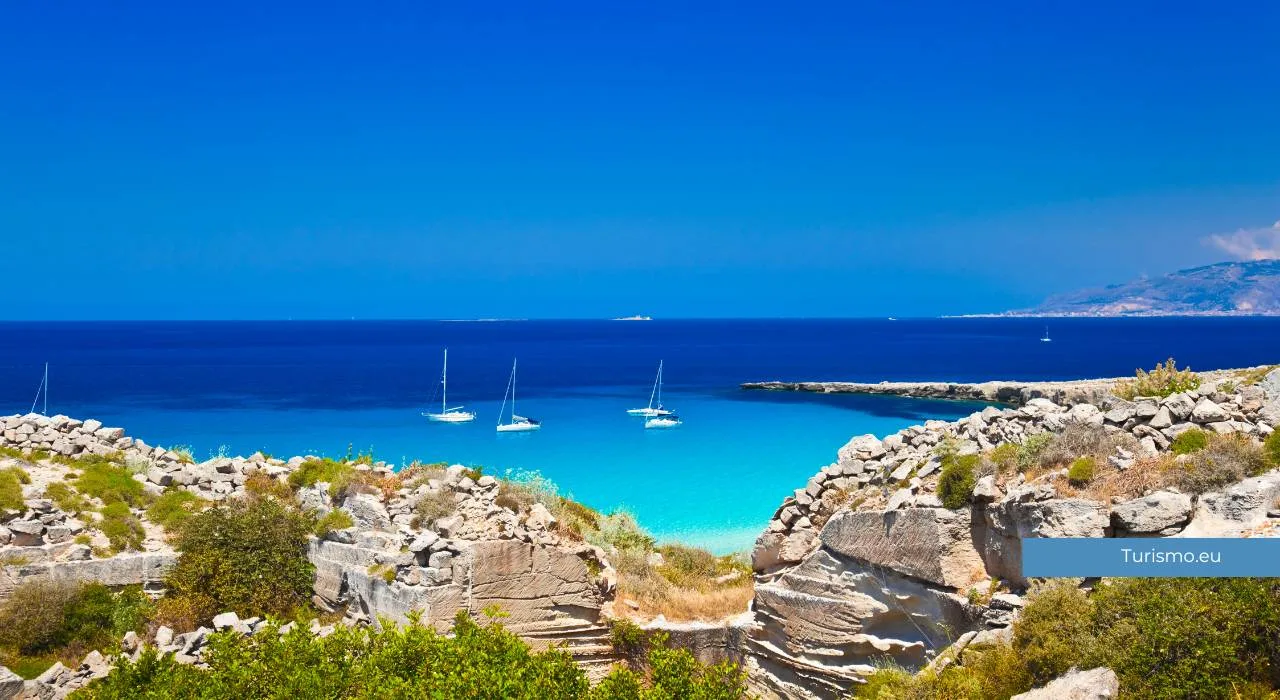


A few kilometres off the western coast of Sicily, opposite Trapani, the Egadi Islands form a small archipelago consisting of Favignana, Levanzo and Marettimo, together with the islets of Formica and Maraone.
The three main islands are very different. Favignana is the largest and easiest to explore, with numerous coves and terrain suited to cycling. Levanzo is small and compact, while Marettimo has a mountainous interior, walking trails and a coastline filled with sea caves.
The surrounding waters form part of the Egadi Islands Marine Protected Area, established to protect the habitats, seabed and marine species found in this part of the Mediterranean.
Which Egadi island should you choose?
It is not necessary to visit all three islands during the same trip. The best choice depends on the time available and, above all, the kind of holiday you want.
Favignana is the most suitable island for a first trip to the Egadi archipelago and for travellers who want to combine beaches, coves and cultural visits. It also offers the widest selection of accommodation and services.
Levanzo is much smaller and can also be visited as a day trip. It is particularly interesting for the Grotta del Genovese and for travellers looking for an island to explore mainly on foot and by boat.
Marettimo requires more time. Its mountainous landscape, walking trails and sea caves make it especially suitable for combining swimming and hiking.
Favignana: coves, quarries and tuna fishing history
Favignana is the largest and most visited of the Egadi Islands. Seen from above, it is often described as having the shape of a butterfly, with Monte Santa Caterina in the centre and two sections of land extending east and west.
The island’s landscape alternates between rocky coastline, sandy areas and former calcarenite quarries, which have left deep cuts in the terrain.
Some of the best-known coastal locations include:
- Cala Rossa, surrounded by the walls of former quarries;
- Cala Azzurra, with shallow, pale seabeds;
- Lido Burrone, one of the island’s principal sandy beaches;
- Bue Marino, characterised by tall calcarenite cliffs;
- Grotta Perciata, on the eastern coast.
Sea conditions vary considerably according to the wind. During a stay of several days, it is therefore better to choose the most sheltered side of the island each day rather than plan a fixed sequence of beaches in advance.
Former Florio Tuna Fishery
Near the harbour stands the Former Florio Tuna Fishery of Favignana and Formica, one of the most useful places for understanding the island’s economic and social history.
The large industrial complex is connected with tuna processing and the Florio family, who played an important role in developing the industry between the 19th and 20th centuries.
The buildings now contain a museum devoted to tuna fishing, the former fishery and the history of Favignana.
The quarries of Favignana
The extraction of calcarenite profoundly shaped the island’s landscape. Abandoned quarries now form unusual environments of vertical walls, tunnels and excavated spaces, some of which have been converted into gardens and vegetable plots.
This part of the island reveals a side of Favignana beyond its beaches and explains the distinctive appearance of many areas.
Levanzo: the smallest Egadi island
Levanzo is the smallest of the three main islands. Its village consists of pale houses arranged around the small harbour and contains most of the available services.
Distances are short, but the terrain is largely rocky and many places can be reached only by walking trails or from the sea.
The best-known coves include Cala Fredda and Cala Minnola.
Grotta del Genovese
Levanzo’s most important historical site is the Grotta del Genovese, which contains prehistoric engravings and paintings dating from different periods.
The cave lies inland, and visits must follow the established access arrangements. Availability and booking requirements should therefore be checked before travelling to the island.
These prehistoric remains also make Levanzo interesting outside the summer beach season.
Marettimo: trails, mountains and sea caves
Marettimo is the westernmost of the Egadi Islands and has a landscape very different from the flatter terrain of Favignana.
Mountains occupy much of the island, and a network of walking trails leads to viewpoints, wooded areas and stretches of coastline far from the village.
One of the best-known walks leads towards Punta Troia, where a castle overlooks the headland and the surrounding sea.
Another way to explore Marettimo is by taking a boat around the island. Its coastline contains numerous cavities and sea caves that can be reached when conditions allow.
Travellers choosing Marettimo should spend at least a few days on the island. A day trip provides enough time to see the village and part of the coastline, but leaves little opportunity for walking the trails.
How to reach the Egadi Islands
The main departure point for the Egadi Islands is Trapani, which has regular hydrofoil and ferry connections with all three islands.
Favignana is generally the first island reached and has the most frequent services. Levanzo and Marettimo lie progressively further west.
Routes and frequencies vary throughout the year, with more crossings during summer. Up-to-date timetables should therefore be checked with the ferry companies before departure.
Getting between the Egadi Islands
Hydrofoils connect Favignana, Levanzo and Marettimo, making it possible to include more than one island in the same trip.
Favignana’s relatively small size and predominantly flat eastern section make it suitable for exploring by bicycle. Scooters and other vehicles available on the island can also be used to reach more distant areas.
Levanzo is explored mainly on foot and by sea.
On Marettimo, much of the island is reached by walking trails, while boat trips provide access to the caves and views of stretches of coastline that are difficult to approach from land.
How many days to spend in the Egadi Islands
Three or four days can be sufficient for a first visit to Favignana, particularly when the main aim is to alternate between beaches and exploring the island.
With one week, it is possible to combine Favignana with Levanzo and spend a few days on Marettimo.
Travellers who want to walk the trails, spend full days by the sea and experience all three islands without constant transfers should allow more time.
Favignana does not necessarily have to be used as the only base. Staying overnight on Levanzo or Marettimo provides an opportunity to experience these islands after the day visitors have left.
When to visit the Egadi Islands
From June to September, the Egadi Islands experience their busiest tourist season and ferry connections are more frequent.
July and August are also the most crowded months, particularly on Favignana and at its best-known coves.
June and September offer a good balance for swimming, walking and travelling between the islands, with temperatures generally lower than during the height of summer.
Spring and autumn can be suitable for walking and exploring the landscape, but ferry services are less frequent and some businesses close outside the main season.
Three very different islands
Their geographical proximity should not suggest that Favignana, Levanzo and Marettimo are interchangeable.
Favignana offers the widest variety of beaches, services and places to visit. Levanzo combines coastline, walking trails and prehistoric remains within a small area. Marettimo requires more time and is better suited to hiking, mountain scenery and exploring the coast.
Before organising the trip, it is therefore worth deciding whether to spend a few days getting to know one island properly or divide the stay between several different bases.