

In Agrigento, the modern city occupies the hill while, further below, a long ridge follows the line of the temples of ancient Akragas. Columns rise among almond trees, olive groves and open fields, with the Mediterranean in the distance.
The name can be misleading because the principal monuments do not stand at the bottom of a valley. They were built along the elevated southern boundary of the ancient city.
The archaeological route is extensive and almost entirely outdoors. It requires at least several hours and careful planning, particularly during the summer.
In addition to the archaeological area, Agrigento has a historic centre built across steep slopes, the Regional Archaeological Museum and the Kolymbethra Garden. Porto Empedocle and the Scala dei Turchi lie along the nearby coast but are better treated as a separate excursion rather than a quick extension of the temple visit.
Agrigento and ancient Akragas
Akragas was founded by the Greeks in the sixth century BC and became one of the most important cities in the Mediterranean.
The large Doric temples constructed along the southern boundary of the settlement reflected the wealth and power achieved by the city.
The territory later came under Roman control and was renamed Agrigentum. It continued to change over the following centuries, gradually moving towards the hill where the medieval centre now stands.
The archaeological area became a UNESCO World Heritage Site in 1997. Its importance lies not only in the preservation of the temples but also in the scale of the site and the relationship between the archaeological remains and the surrounding rural landscape.
How to visit the Valley of the Temples
The Valley of the Temples covers a very large area. The principal route connects the entrance near the Temple of Juno with Porta V, passing the Temple of Concordia and the other monumental areas.
One of the most practical options is to enter at Juno, in the upper section, and continue downhill towards Porta V. This avoids retracing the entire route in the opposite direction. However, it is necessary to arrange transport back to the car park or use the available connection between the entrances.
Visitors with less time can enter at Juno, walk as far as the Temple of Concordia and then return to the same entrance. This option covers the best-preserved monuments but excludes much of the western sector.
Allow at least three or four hours for a complete visit. Adding the Kolymbethra Garden, a guided tour or the archaeological museum can easily turn the Valley into a full-day experience.
The route from the Juno entrance
Entering from the eastern side, the first major monument is the so-called Temple of Juno.
The names traditionally assigned to several temples in Agrigento derive from historical interpretations. In many cases, the deity to whom the building was originally dedicated is not known with certainty.
Its elevated position provides a view over the ridge and helps explain the relationship between the defensive system of the ancient city, its sanctuaries and the coastal plain.
From the temple, the route continues along the Via Sacra, passing olive trees, almond trees and remains of the ancient fortifications. This section is exposed to the sun but clearly reveals the structure and scale of the site.
The Temple of Concordia
The Temple of Concordia is the best-preserved monument in the Valley and one of the most complete surviving Doric buildings in the world.
Its survival is partly connected with its conversion into a Christian building during late antiquity. Alterations made over the centuries helped preserve the structure, which was later returned to an appearance closer to its original form.
A large early Christian necropolis extends around the temple. Rock-cut tombs and burial chambers show that this area continued to be used long after the decline of the Greek city.
The Temple of Heracles
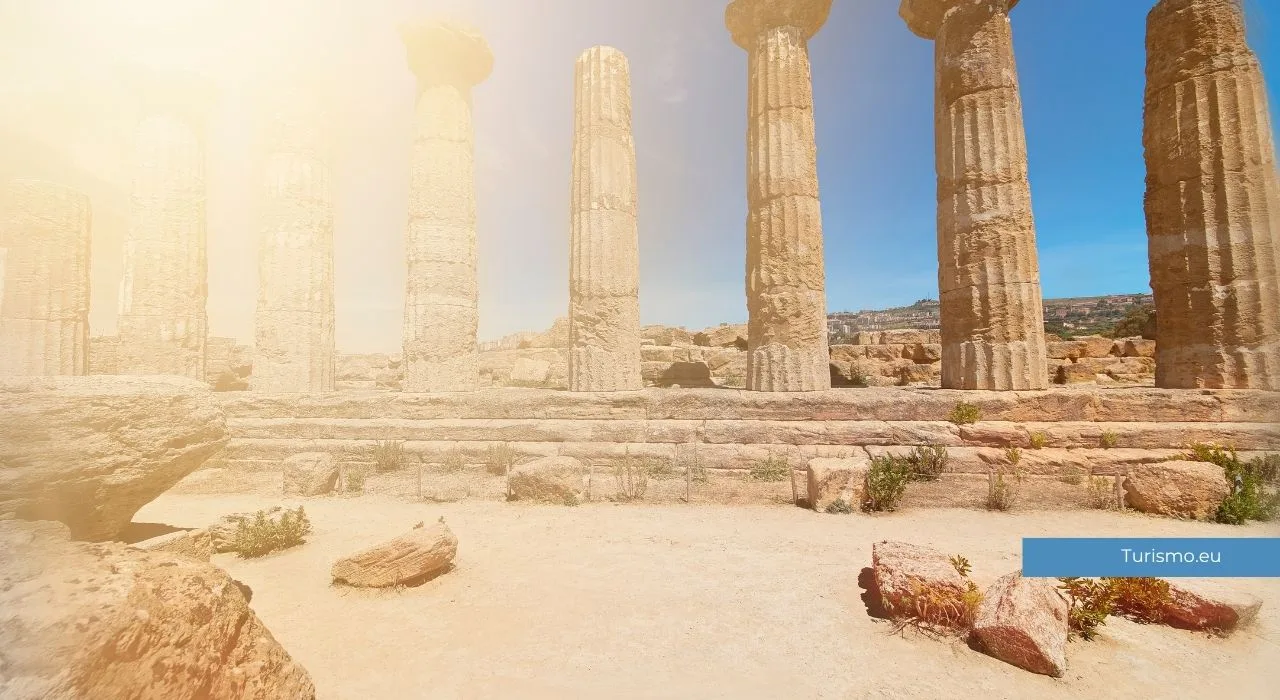
Continuing west leads to the Temple of Heracles, considered one of the oldest temples in the Valley.
Its most recognisable feature is the row of columns re-erected during the twentieth century. The structure is much more fragmentary than the Temple of Concordia, but it still provides an idea of the building’s original dimensions and the way the monuments followed the profile of the ridge.
The Temple of Olympian Zeus and the telamons
The Temple of Olympian Zeus was designed on an exceptional scale, probably to celebrate the victory of Akragas over the Carthaginians at the Battle of Himera.
The building did not follow the open and regular structure associated with better-known Doric temples. Its unusual architectural elements included enormous male stone figures known as telamons, incorporated into the building for decorative and symbolic purposes.
The site now consists of a vast collection of collapsed blocks. Without a plan or explanation, it can be difficult to reconstruct the original appearance of the temple. However, the size of the surviving fragments conveys the ambition of the project.
The Temple of the Dioscuri
The four columns of the Temple of the Dioscuri, topped by a section of entablature, have become one of the symbols of Agrigento.
Their present appearance, however, is the result of a nineteenth-century reconstruction using elements from different buildings. It should not therefore be interpreted as a temple preserved intact in its original position.
The interest of this sector lies mainly in the surrounding group of sanctuaries dedicated to chthonic deities, the remains of altars and the landscape descending towards the Kolymbethra Garden.
The Kolymbethra Garden
The Kolymbethra Garden lies between the Temple of the Dioscuri and the Temple of Vulcan and is managed by the Italian National Trust, FAI.
In antiquity, this natural depression was connected to a complex hydraulic system and collected water from the city. Over time, it developed into an agricultural area planted with citrus trees, olive trees, almonds, mulberries and other fruit trees.
The visit descends from the most exposed sections of the Valley into a cooler, more enclosed environment. Earthen paths pass between walls, irrigation channels and agricultural terraces, showing a side of Agrigento that is not exclusively archaeological.
Entry to the garden requires a separate or combined ticket. Opening hours change throughout the year, and final admission takes place before the official closing time.
On selected dates, visitors can also join a guided tour of the underground hypogea for an additional charge. These tours take place in small groups and require closed footwear.
Allow at least one hour for the Kolymbethra Garden. Including it in the visit involves additional slopes and changes in elevation.
Pietro Griffo Regional Archaeological Museum
The Regional Archaeological Museum stands between the modern city and the Valley of the Temples.
Its collection includes pottery, sculpture, grave goods and a telamon from the area of the Temple of Olympian Zeus.
The museum provides useful context for the archaeological site, although it is generally better to visit it separately rather than immediately after completing the full route through the Valley.
Opening hours and combined ticket arrangements should be checked through official channels.
Agrigento’s historic centre
Agrigento’s historic centre occupies the hill overlooking the Valley. Via Atenea is its main thoroughfare, lined with shops, restaurants and side streets climbing towards the oldest neighbourhoods.
Its appeal is not concentrated in a single monument. Stairways, narrow streets, courtyards and sudden openings towards the landscape form an irregular urban structure that contrasts with the geometry of the archaeological site.
A few hours are sufficient for a first visit. It is possible to follow Via Atenea and climb towards the higher districts, choosing a few diversions without attempting to reach every building marked on the map.
The slopes are considerable and some sections have long stairways. Comfortable footwear is therefore useful in the city as well as in the Valley of the Temples.
The centre is particularly pleasant in the late afternoon or evening, leaving the cooler hours of the day for the archaeological area.
Agrigento in one day
Agrigento can be visited in one day, but priorities must be established.
A balanced plan could include:
- entering the Valley of the Temples in the morning;
- walking from the Juno entrance to Porta V;
- visiting the Kolymbethra Garden if time and temperatures allow;
- exploring the historic centre in the late afternoon or evening.
During summer, it may be better to enter the Valley later in the day and take advantage of any evening opening hours. The illuminated temples offer a different perspective and temperatures are usually more manageable.
Agrigento in two days
Two days allow for a more complete visit.
Day one: Valley of the Temples and Kolymbethra
The first day can be devoted entirely to the archaeological park, without compressing the route.
The Kolymbethra Garden provides a break from the most exposed sections and helps interpret the Valley as an agricultural landscape as well as an archaeological site.
In the evening, head up to the historic centre for dinner and a walk along Via Atenea.
Day two: the coast
The second day can be dedicated to the coast, combining Porto Empedocle, the beaches around Realmonte and the Scala dei Turchi.
The order of the stops should be determined by the allocated access time for the Scala. If the visit is scheduled for the afternoon, the morning can be spent in Porto Empedocle or on the beach.
Scala dei Turchi: access and booking
The Scala dei Turchi lies approximately 15 kilometres from Agrigento.
It is a white marl cliff shaped by erosion and recognised by the natural steps descending towards the sea.
Access to the marl surface is controlled and limited. Booking arrangements, opening hours and access conditions may change, so current official information must be checked before visiting.
Access may be suspended because of rain, strong winds, rough seas, high temperatures or other conditions affecting safety.
Shoes with soft, non-slip soles are recommended. Removing pieces of marl, carving the surface or placing objects on it that could cause damage is prohibited.
Even when direct access to the cliff is unavailable, the Scala dei Turchi can still be viewed from the beach and nearby viewpoints.
When to visit Agrigento
Spring and autumn are generally the best seasons for visiting Agrigento. Temperatures are more comfortable for walking, and the landscape surrounding the temples has a greater variety of colours than during the driest months.
Between February and March, flowering almond trees change the appearance of the Valley and often coincide with events connected with the Mandorlo in Fiore festival.
Summer can be extremely hot. The archaeological route provides little shade and walking during the middle of the day can be exhausting. It is better to enter early in the morning or towards the end of the afternoon, checking whether evening visits are available.
The Valley can also be visited during winter, although wind and rain may affect the experience. Stone and earthen surfaces can become slippery.
Practical information for the Valley of the Temples
The Valley is normally open every day, although hours are extended during summer and may change for events or exhibitions. Updated information should be checked through the official ticketing service before visiting.
The principal entrances are:
- the Temple of Juno entrance, in the higher eastern section;
- Porta V, near the western sector and the Kolymbethra Garden.
Paid car parks are available near the entrances. Anyone walking through the Valley in one direction should plan how to return to the original car park.
Water, a hat and sun protection are essential. The length of the route and the lack of shade should not be underestimated, particularly between June and September.
Bicycles and electric scooters are not permitted. Electric wheelchairs may be available free of charge by advance reservation for visitors with specific mobility requirements.
How to reach Agrigento
Agrigento is connected by train and coach with Palermo and other Sicilian cities, although journey times should be considered carefully.
The railway station is close to the city centre rather than the Valley of the Temples. Local buses, a taxi or a private vehicle are required to reach the archaeological park.
A car makes it easier to combine Agrigento with the Scala dei Turchi, Porto Empedocle and other places along the southern coast. It is not essential for travellers planning to remain in the city and visit only the Valley.
Agrigento can be included in a journey through western or southern Sicily, but distances across the island should not be underestimated. Spending at least one night in the area is preferable to attempting a rushed day trip from Palermo or Catania.