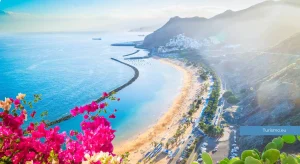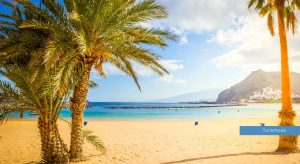
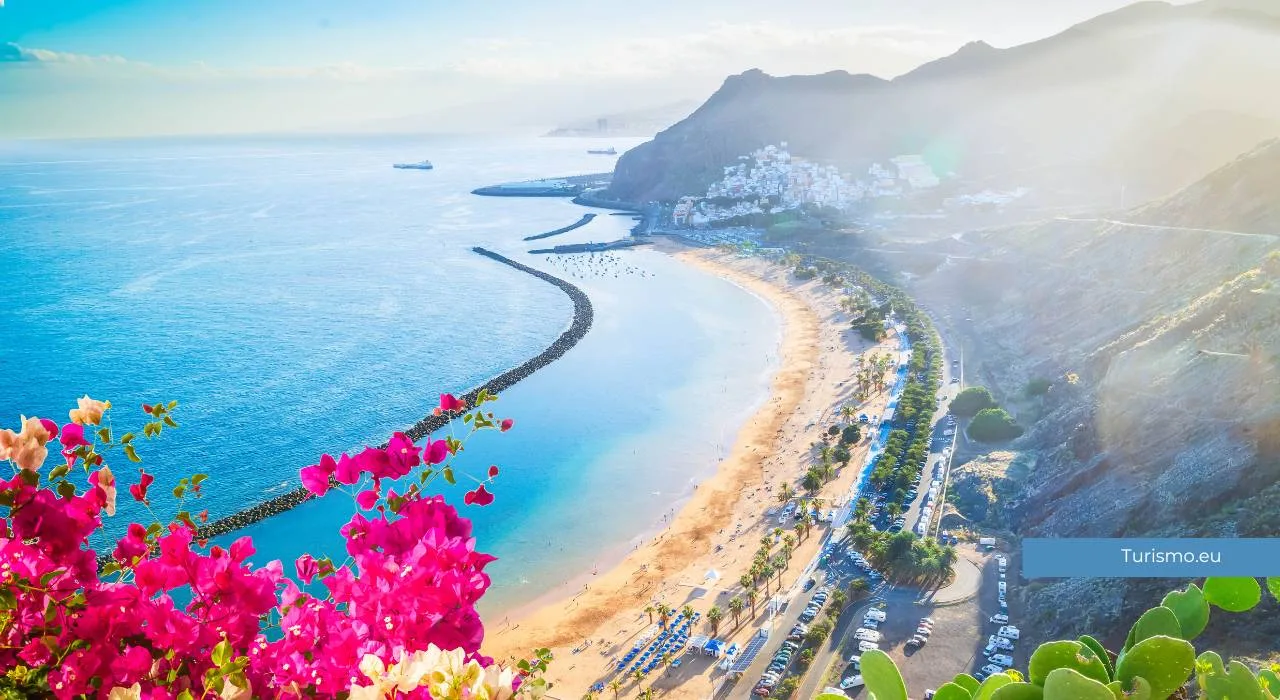


A long stretch of pale sand, a line of palm trees, generally calm water and the Anaga mountains in the background: Playa de Las Teresitas looks very different from the volcanic beaches along Tenerife’s northern coast.
It lies beside the village of San Andrés, approximately eight kilometres from the centre of Santa Cruz, and is one of the beaches most frequently visited by residents of the capital. It is neither a hidden cove nor an untouched section of coastline: Las Teresitas was reshaped by human intervention and is now an easily accessible beach with numerous facilities.
Its appeal comes from the meeting of very different elements. On one side are the imported sand, the breakwater and the large car park; on the other are the slopes of Anaga, the village of San Andrés and the palm trees lining much of the beach.
A beach transformed during the 1970s
The first thing visitors notice on arriving at Las Teresitas is the colour of the sand. Rocks, pebbles and dark volcanic sand dominate much of Tenerife’s northern coast, while this beach is wide and golden.
Las Teresitas acquired its present appearance during the 1970s. The original coastline consisted mainly of pebbles, black sand and small inlets used by the residents of San Andrés.
Sand was brought from the Sahara to create the new beach, while a long breakwater was built offshore. Las Teresitas opened in 1973 and gradually became the main bathing area for Santa Cruz.
It is therefore an artificial beach, but one surrounded by a distinctive landscape. The Anaga Massif rises behind it, while San Andrés stands at the end closest to the capital.
The atmosphere at Las Teresitas
Las Teresitas has a different atmosphere from the beaches of Costa Adeje and Playa de las Américas.
It is particularly popular with residents of Santa Cruz, especially at weekends, but also attracts visitors from other parts of the island. There are no large hotels directly overlooking the sand and no commercial promenade comparable to those in the south.
At weekends, the beach can fill with families and groups of friends carrying umbrellas, music and food from home. Weekdays, particularly in the morning, are generally quieter.
Las Teresitas is neither isolated nor silent, but it remains more closely connected to everyday life in the Santa Cruz area than the resorts built primarily around tourism.
What is the sea like at Las Teresitas?
The breakwater protects much of the beach from Atlantic waves. The water is therefore generally calmer than at many beaches in northern Tenerife.
Entry into the sea is gradual in several sections, and conditions can be suitable for children and swimmers who prefer to avoid strong waves. The depth is not uniform along the whole beach, however, and increases towards the breakwater.
Wind, tides and weather conditions can still affect the sea. Visitors should check the warning flag and follow the instructions of the lifeguards before entering the water.
The seabed is mainly sandy. Sand suspended in the water can reduce visibility, especially on busy days or when the sea is slightly rough.
Las Teresitas is pleasant for swimming, walking through the shallows and using a stand-up paddleboard when conditions allow. It is not, however, one of Tenerife’s most interesting beaches for snorkelling.
Palm trees and shaded areas
Numerous palm trees grow along the beach and have become one of the most recognisable features of Las Teresitas.
Some provide shade directly on the sand, but these spaces are occupied quickly, particularly during summer and at weekends. Tamarisks and other plants able to tolerate the salty environment also grow along the beach.
Those hoping to find a shaded spot should arrive in the morning. Sun protection is still essential, as ultraviolet exposure in the Canary Islands can remain high even when the sky is cloudy.
Beach facilities and kiosks
Las Teresitas is one of the best-equipped beaches in the Santa Cruz metropolitan area.
Facilities include toilets, showers, waste bins, lifeguards and accessible entrances for people with reduced mobility. Sunbeds are also available to hire, and water-based activities are offered during certain periods.
Kiosks along the beach sell drinks, snacks and simple meals. Their opening hours and services can vary during the year, so they should not be considered the only option for food, particularly outside the main season.
For a wider choice, visitors can walk to San Andrés, where there are numerous restaurants specialising in fish and Canarian cuisine.
San Andrés, the village beside the beach
San Andrés lies a few minutes on foot from the western end of Las Teresitas. The settlement existed long before the beach was transformed and remains distinct from nearby Santa Cruz.
Its houses stand between the sea and the first slopes of Anaga, along narrow streets crossed by the main road. Its proximity to the capital and the popularity of Las Teresitas have changed the village, but its connection with fishing remains visible, particularly in its restaurants.
Combining a visit to the beach with lunch in San Andrés is easy. On busy days, however, restaurants can fill quickly and traffic tends to build up along the road through the village.
Seeing Las Teresitas from above
One of the best-known views of Las Teresitas can be seen from the road climbing towards Igueste de San Andrés.
From above, it is possible to see the curve of the beach, the breakwater, the palm trees, San Andrés and the port of Santa Cruz in the distance. The detour is particularly worthwhile for those continuing along this part of the Anaga coast.
Roadside space is limited, and not every lay-by is intended for parking. Drivers should stop only where this is permitted, without obstructing the road or access points.
How to reach Playa de Las Teresitas
By car
From central Santa Cruz, follow Avenida de Anaga and continue along the TF-11 towards San Andrés. After passing through the village, the road leads directly to the beach.
Under normal conditions, the journey takes approximately 15 to 20 minutes. Traffic can build up before San Andrés on summer weekends, public holidays and particularly hot days.
There is a large free car park beside the beach. Despite its size, it can fill during the busiest periods. Santa Cruz City Council provides online information about its current level of occupancy.
During summer and at weekends, it is best to arrive in the morning or use public transport.
By bus from Santa Cruz
TITSA bus route 910 connects the Santa Cruz bus station with San Andrés and Playa de Las Teresitas.
The journey usually takes around 20 minutes, although traffic can increase the travel time. Timetables change between summer and winter and should be checked before departure.
The final stop is close to the beach entrances. The bus is particularly convenient for visitors staying in Santa Cruz who want to avoid looking for a parking space.
When to visit Las Teresitas
The beach can be visited throughout the year, although the climate of north-eastern Tenerife does not always match conditions in the southern resorts.
Summer
From June to September, days are generally warmer and the beach is heavily used, particularly at weekends. Arriving early is advisable for those hoping to find parking and a shaded area.
Spring and autumn
These seasons are suitable for combining a few hours at the beach with a visit to Santa Cruz or the Anaga Peninsula. Visitor numbers are often lower than in summer, except on public holidays and particularly warm days.
Winter
Winter can still bring days suitable for the beach, but sunshine should not be taken for granted. Clouds may cover Las Teresitas while southern Tenerife remains clear.
Before planning a day entirely by the sea, it is worth checking the specific forecast for Santa Cruz and Anaga rather than a general forecast for the whole island.
Is Las Teresitas suitable for children?
Las Teresitas is one of Tenerife’s most convenient beaches for families. Its generally sheltered water, wide stretch of sand, facilities and easy access make a day here simpler than at the natural beaches of Anaga.
Children must still be supervised in the water, and lifeguard warnings should always be followed. The depth and seabed conditions are not identical along the entire beach and can change with the tides.
The pale sand heats up less quickly than black volcanic sand, although it can still become very hot during the middle of the day.
Las Teresitas is therefore a good choice for visitors staying in Santa Cruz, travelling with children or looking for generally calmer water without travelling to the tourist resorts in southern Tenerife.