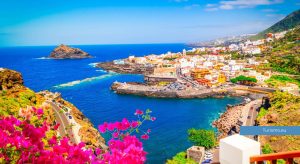
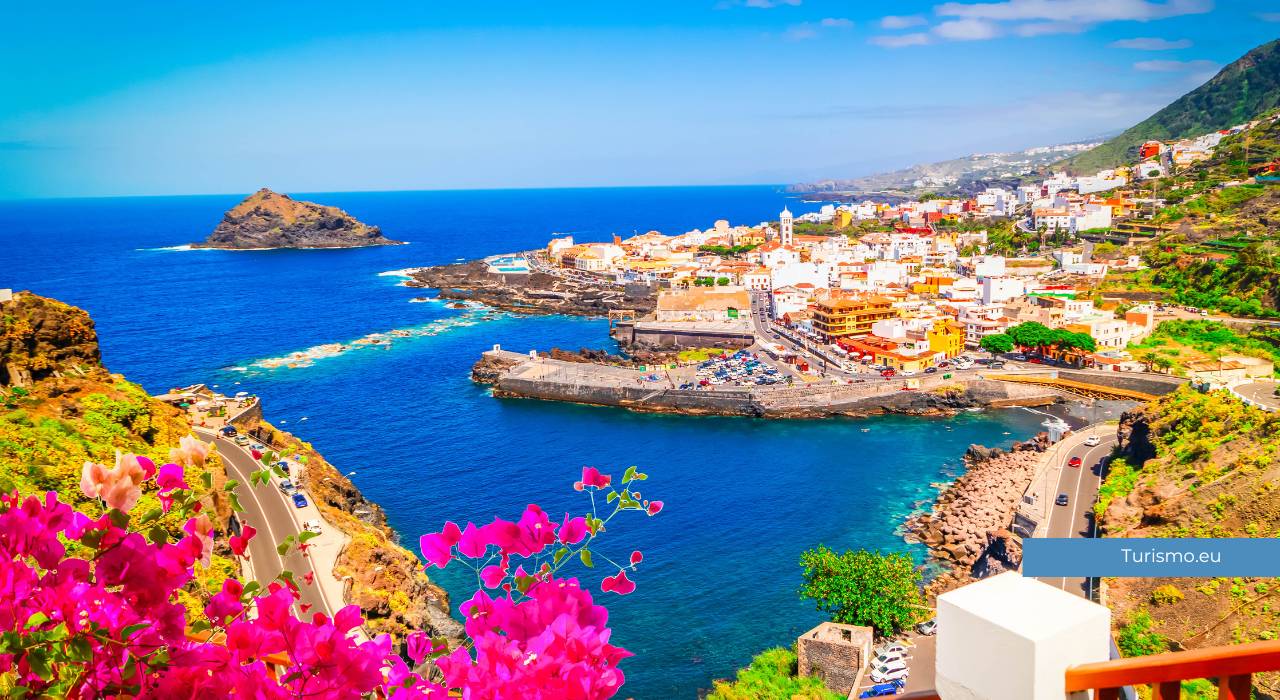


Garachico stands on the northwestern coast of Tenerife, at the foot of a steep slope that seems to leave little space between the mountains and the Atlantic Ocean. White houses, dark stone buildings and tree-lined squares form one of the best-preserved historic centres on the island, while lava flows have created natural pools and inlets along the coast.
Lava is not merely part of the landscape. In 1706, it reached the town, buried the harbour and changed the fate of what had until then been one of Tenerife’s most important trading centres. Garachico was rebuilt, but it never regained the economic importance it had enjoyed in previous centuries.
Today, it is a compact town that can easily be explored on foot. The history of the eruption is visible everywhere: in the black rocks of El Caletón, in the remains of the old harbour and in the buildings that survived or were later rebuilt. A visit can take just a few hours, but staying longer offers a chance to experience Garachico after the day-trippers leave and its squares once again become gathering places for local residents.
What to see in Garachico
The centre is small and does not require a fixed itinerary. You can begin by the sea, cross the main squares and then gradually make your way up through the inner streets. Distances are short, and many of the most interesting buildings are concentrated around Plaza de la Libertad.
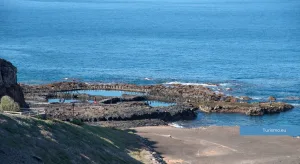
El Caletón and its natural pools
El Caletón is Garachico’s best-known attraction. Rather than a single pool, it consists of several natural basins and channels formed when lava came into contact with the sea.
Steps, walkways and paved areas provide access to the water and connect the different pools. Some are relatively sheltered, while others are more directly exposed to the ocean.
On calm days, the water may appear peaceful, particularly inside the most protected pools. When strong waves arrive, however, conditions can change quickly: water rises over the rocks, floods the platforms and may create dangerous currents.
Before swimming, observe the sea, respect any restrictions and follow the instructions provided by staff. The fact that El Caletón is described as a “natural pool” does not mean that it offers the controlled conditions of a conventional swimming pool. The official Tenerife Tourism website also recommends caution because waves along this stretch of coast can be powerful.
The rocks are uneven and slippery in places. Water shoes can be useful, especially for children and anyone unaccustomed to walking over volcanic rock.
If sea conditions make swimming unsafe, El Caletón is still worth visiting to see how the lava flows reshaped the coastline.
Castillo de San Miguel
Beside the natural pools stands Castillo de San Miguel, a small square fortress built in the 16th century to protect the harbour.
Its position helps visitors imagine the former coastline and Garachico’s relationship with the sea before the eruption. The castle survived the lava and now provides one of the clearest links between the town’s maritime past and its volcanic landscape.
The building has been declared a Site of Cultural Interest. Opening times for the interior may vary, but it is still worth viewing from outside for its stone walls and its position beside the volcanic rocks of El Caletón.
Plaza de la Libertad
Plaza de la Libertad is the heart of Garachico’s historic centre. It is surrounded by some of the town’s most important buildings and has benches, trees and cafés with outdoor seating.
During quieter hours, the square reveals the everyday character of the town: people sitting in the shade, children crossing the square and residents meeting outside the cafés.
At its centre stands a statue dedicated to Simón Bolívar, whose paternal family originated in Garachico. The square is bordered by the Church of Santa Ana, the former Convent of San Francisco and several historic civic buildings.
Puerta de Tierra
Parque de la Puerta de Tierra occupies part of the area that once separated the town from the harbour. Inside the park stands the preserved arch through which people and goods passed on their way to the docks.
The gate now lies some distance from the water because the eruption filled the bay and moved the coastline. It is a simple structure, but it clearly shows how profoundly the lava transformed Garachico.
The park contains trees, tropical plants and several remains connected with the former harbour activities. A visit takes little time and provides a pleasant shaded break.
Muelle Viejo
The old pier is one of the best places to understand the relationship between Garachico and the Atlantic. Little remains of the once-important commercial harbour, but the area is still used for walking, fishing and reaching the small Playa del Muelle.
From the pier, you can see the outline of the coast, the lava flows and Roque de Garachico. It is also a pleasant place to stop towards the end of the day, when the light reaches the façades of the historic centre and the rocks along the shore.
The Monument to the Emigrant
On the seafront, slightly removed from the centre, stands the Mirador del Emigrante. Its sculpture depicts a human figure carrying objects and parts of its own body, evoking the separation experienced by those who left the Canary Islands in search of work, particularly in the Americas.
The sculpture stands above an area of volcanic rock and faces the ocean. The viewpoint also offers views of the town, the modern harbour and the steep slope rising behind Garachico.
Roque de Garachico
Roque de Garachico is a volcanic islet rising more than 70 metres above the sea just off the coast. Separated from the mainland, it is a protected natural area of particular importance to seabirds.
The rock has become one of the symbols of Garachico and can be seen clearly from Muelle Viejo, the harbour and the viewpoints along the roads descending towards the town.
It is not a place to attempt to reach independently. Its value is primarily natural and scenic, and protecting the islet means avoiding any disturbance to its wildlife.
How long to spend in Garachico
Two or three hours may be enough to explore the historic centre without entering its buildings. However, it is better to allow at least half a day, especially if you want to walk along the seafront and stop for lunch.
If you intend to spend a few hours at the natural pools, dedicate a full day to Garachico. Adding Icod, Masca, Punta de Teno and several other places to the same day can easily turn the itinerary into a rushed sequence of short stops.
When to visit Garachico
Garachico can be visited throughout the year. However, the weather on Tenerife’s northern coast is more variable than in the tourist resorts of the south.
Spring and autumn are good times to walk around the centre and explore the Isla Baja area. Visitor numbers increase in summer and the natural pools become particularly busy, so it is advisable to arrive in the morning.
Winter can also bring mild and sunny days, although the coast is more exposed to Atlantic waves. If swimming at El Caletón is your main reason for visiting, check local sea conditions shortly before setting out.
Where to park
Garachico has several parking areas around the centre, but finding a space can take time at weekends, during the summer and on local festival days.
One of the most convenient areas is near the harbour and sports ground, east of the historic centre. From there, both the centre and the seafront can be reached on foot.
It is best to avoid driving into the narrowest streets. Once parked, all the main places of interest are within walking distance.
What to see near Garachico
Garachico can easily be combined with Icod de los Vinos, approximately ten minutes away by car and known primarily for the Drago Milenario and Cueva del Viento.
Continuing west leads to Los Silos and Buenavista del Norte, two towns that offer an opportunity to explore the Isla Baja beyond its most visited attractions. Connections to Punta de Teno also depart from Buenavista, although access is regulated during certain hours.
Masca appears relatively close on the map, but the road is slow and winding. Visiting both places in one day is possible, although it requires careful planning.