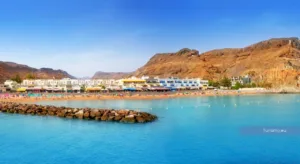
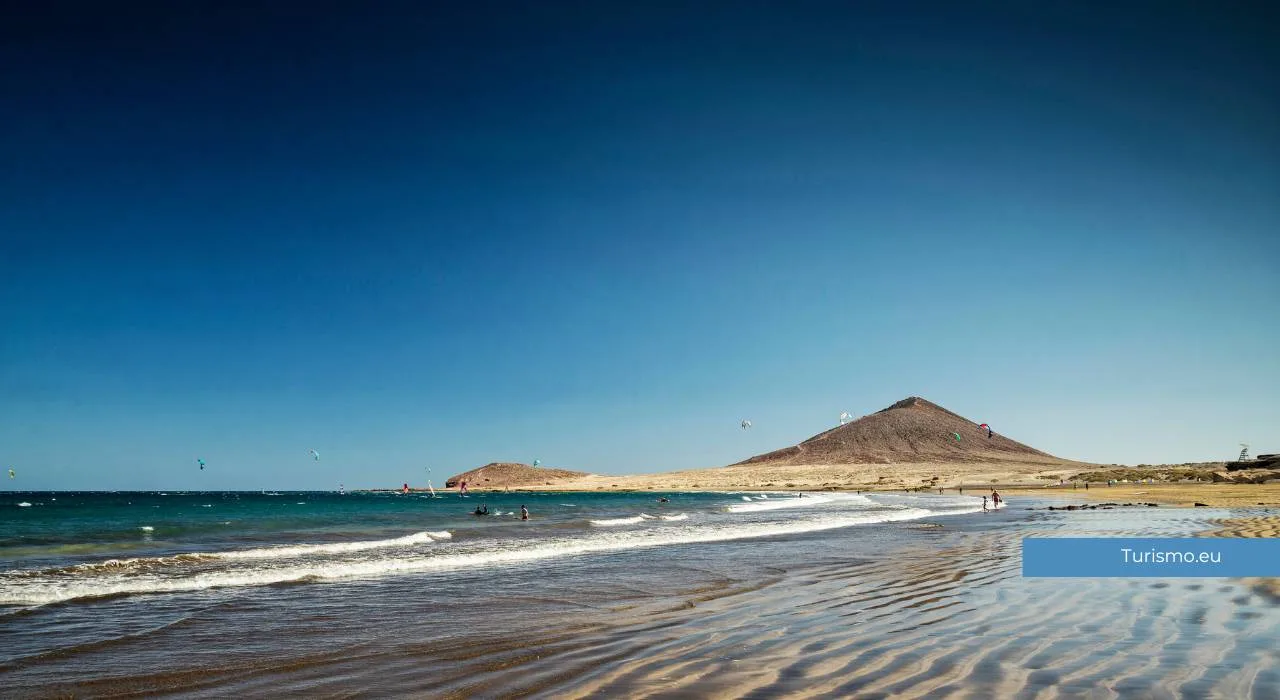
Southern Tenerife is often associated with large hotel complexes and resorts built around beach tourism. El Médano shows a different side of this part of the island: an oceanfront town where the wind blows almost every day and the reddish outline of an ancient volcanic cone dominates the landscape.
Here, the seafront promenade gradually gives way to sand, low dunes and the dry terrain of the Montaña Roja Special Nature Reserve. Within a few kilometres, you will find beaches suited to different preferences, coastal paths and one of the Canary Islands’ most popular spots for windsurfing and kitesurfing.
El Médano can be visited on a day trip, but it also makes a good base for anyone who wants to stay in southern Tenerife away from the main resort areas of Costa Adeje and Playa de las Américas.
Where is El Médano?
El Médano belongs to the municipality of Granadilla de Abona and lies on Tenerife’s southeastern coast, a short distance from Tenerife South Airport.
Its proximity to the airport makes the town easy to reach, including on the first or last day of your trip. However, it also means occasional aircraft noise, particularly near the coast and the nature reserve.
Compared with the southwest of the island, this area is more exposed to the trade winds. The wind has shaped the landscape and continues to influence beach conditions, sporting activities and even the choice of where to swim.
The town of El Médano
El Médano’s centre stretches along the coast around a small square facing the ocean.
Walkers, runners and people carrying boards and sails share the seafront promenade. Bars, restaurants and water sports shops line the streets near the beach, but the atmosphere remains different from that of the larger resorts in the south.
From the centre, you can walk along the coast towards Montaña Roja. The buildings gradually thin out, and the volcanic cone becomes an increasingly prominent feature.
El Médano is also pleasant in the evening, when the beaches become quieter and the promenade remains one of the town’s main gathering places. However, the wind can continue to blow strongly after sunset.
The beaches of El Médano
The coastline includes several beaches, each with different conditions. Before choosing where to settle, check the wind, waves and activities taking place in the water.
The beach near the town centre
The most sheltered section lies close to the town. The sand is grey, and the seabed generally slopes more gradually than along the more exposed stretches.
This is the most convenient area if you want to combine a swim with a walk around town, with bars and facilities nearby. It is still an Atlantic beach, however: wind, waves and currents can change throughout the day.
Playa de Leocadio Machado
Continuing towards Montaña Roja brings you to the stretch most popular with windsurfers and kitesurfers. Colourful sails are part of El Médano’s landscape and make this section of the coast instantly recognisable.
Anyone entering the water must respect the designated activity zones and keep a suitable distance from people practising water sports. When the wind is strong, this beach is better for watching the action than for a quiet swim.
Playa Chica
On the opposite side of the town centre lies Playa Chica, a small, more enclosed cove. Its limited size and proximity to the houses give it a different feel from the long beach stretching towards Montaña Roja.
It can be a good alternative for a short stop, although the available space fills up quickly during busy periods.
To compare this stretch of coast with other parts of the island, see our guide to the best beaches in Tenerife.
Montaña Roja Special Nature Reserve
Between El Médano and Playa de La Tejita lies the Montaña Roja Special Nature Reserve, a protected area covering around 166 hectares.
Its most visible feature is Montaña Roja, a 171-metre-high volcanic cone formed by a coastal eruption. Material expelled by the volcano created a connection with the rest of the island, leaving two broad beaches on either side.
The reserve includes much more than the mountain itself. Sand, small wetland areas, salt-tolerant vegetation and volcanic terrain form a fragile ecosystem that is also important for seabirds and migratory birds.
The landscape can appear bare, particularly in bright sunlight. Look more closely, however, and you will notice low-growing plants, variations in the colour of the ground and surfaces continually shaped by the wind.
Visitor pressure is high because the reserve borders busy beaches and areas easily reached by car. It is therefore essential to use existing paths, stay out of marked-off areas and leave sand, stones and plants where they are.
Walking around Montaña Roja
A relatively easy coastal walk offers a way to explore the reserve, linking El Médano with the foot of Montaña Roja and continuing towards La Tejita.
There is no single compulsory route: several paths cross the area, allowing you to adapt the distance to the time available. To avoid damaging vegetation and creating new tracks, stay on existing paths and follow the signs.
The coastal stretch is almost entirely exposed to the sun and wind. There are no trees or substantial shaded areas, so even a short walk requires water and a hat.
Underfoot, the terrain alternates between sand, compacted earth and volcanic material. Closed-toe shoes are preferable, especially if you plan to leave the promenade and walk to the mountain.
Climbing Montaña Roja
A path climbs from the foot of the cone to its summit. The distance is short, but the gradient and loose ground make the ascent more demanding than it might appear from the beach.
From the top, you can see El Médano, Playa de La Tejita, the southern coast and, on clear days, Tenerife’s inland hills. However, the mountain’s isolated position leaves the summit particularly exposed to the wind.
Avoid climbing in flip-flops, during the hottest part of the day or when gusts are very strong. The descent also requires care, as gravel and stones can make some sections slippery.
Montaña Roja lies within a nature reserve. Before visiting, check for any temporary restrictions and always follow the instructions on site, particularly during sensitive periods for wildlife.
If you prefer not to climb, you can simply walk around the base. The volcano’s shape and the contrast between reddish earth, sand and ocean are also clearly visible from the coastal path.
Playa de La Tejita
On the western side of Montaña Roja, Playa de La Tejita stretches for more than a kilometre. It is one of the largest natural beaches in southern Tenerife and has a less urban setting than El Médano’s seafront.
The beach is fully exposed and offers very little shade. Wind can lift the sand and make a long stay uncomfortable, while the sea can have strong waves and currents.
The section closest to the mountain includes a small, partly sheltered cove. It has traditionally also been popular with naturists, but sea conditions require the same careful assessment as elsewhere on the beach.
Do not assume La Tejita is a calm swimming beach simply because it is broad and largely undeveloped. Before entering the water, check the flags and observe the ocean conditions.
Windsurfing and kitesurfing
The steady wind has made El Médano one of the Canary Islands’ main centres for windsurfing and kitesurfing. Schools, specialist shops and equipment hire businesses operate along the coast.
Anyone wanting to try these sports should go through a school, particularly if unfamiliar with local currents and the designated water sports zones. The conditions that make El Médano appealing to experienced riders can be challenging for beginners.
Even if you do not take part, it is worth watching the sails from the beach or promenade. On the windiest days, the activity on the water captures the character of this stretch of Tenerife.
When to visit
El Médano can be visited throughout the year. Temperatures are generally mild, but wind and sunshine have more influence on the day’s conditions than the season alone.
Morning is often the best time to walk in the reserve, especially during the warmer months. The wind can strengthen in the afternoon, creating favourable conditions for water sports but making the beach less comfortable for anyone wanting to relax on the sand.
Winter can bring bright days suitable for walking, while in summer it is important to avoid the midday heat. After unusual rainfall or adverse weather, assess trail conditions on site.