
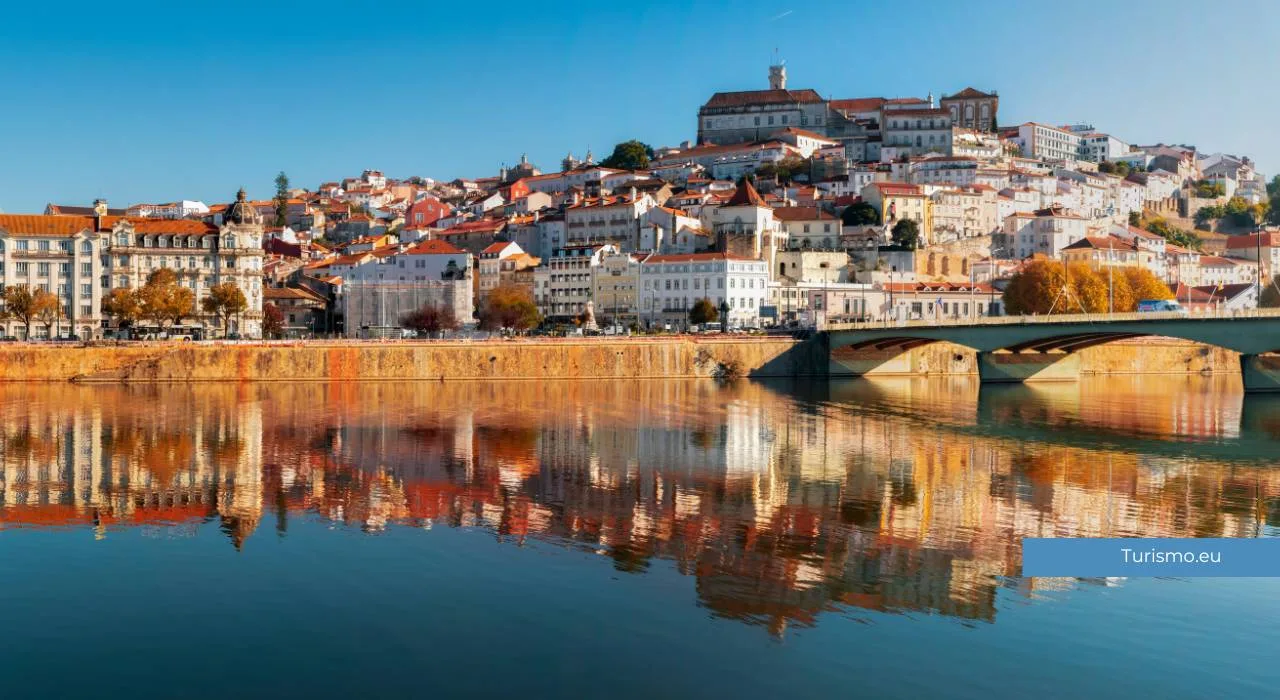
Between Lisbon and Porto, a week gives you time to explore the medieval streets of Óbidos, look out over the Atlantic from the headland at Nazaré, and spend a full day in Coimbra. The route then continues to Aveiro and Costa Nova, where a narrow strip of land separates the lagoon from the ocean.
This itinerary follows the western side of Central Portugal, with a detour inland to visit the monasteries of Alcobaça and Batalha. The seven days are devoted to the stops along the way. Allow extra days if you also want to explore Lisbon and Porto.
A 7-day itinerary through Central Portugal
Day 1 – Lisbon to Óbidos
Enter Óbidos through the Porta da Vila, where a panel of traditional Portuguese tiles decorates the passage beneath the town walls. From here, Rua Direita leads through the old town to the castle, past whitewashed houses, bookshops and places serving ginjinha, a sour cherry liqueur. Near the Church of Santa Maria, turn off the main street and follow the side lanes for different views of the rooftops and walls.
If you plan to walk along the top of the walls, bear in mind that some sections are narrow and have no guardrail. You can also take a walk outside the walls towards the aqueduct. Staying overnight in Óbidos gives you time for another stroll through the town towards the end of the day.
Day 2 – Óbidos Lagoon and Foz do Arelho
From Óbidos, head down to Foz do Arelho, where the lagoon meets the Atlantic. On one side are the sheltered waters of the lagoon. On the other is a beach open to the ocean swell. Take a walk along the shore and stop for lunch before continuing north.
If you fancy another stop, São Martinho do Porto is on the way to Nazaré. Its almost circular bay opens to the ocean through a narrow gap, giving it a different feel from the coast at Foz do Arelho. Aim to reach Nazaré in the afternoon and finish the day with a walk along the seafront.
Day 3 – Nazaré, from the seafront to Praia do Norte
Start in the lower part of Nazaré, where you can still see traditional fishing boats and racks used for drying fish on the beach. From the seafront, take the funicular up to Sítio, the neighbourhood built on top of the headland.
The Miradouro do Suberco overlooks the bay and the row of houses along the beach. After visiting the Sanctuary of Nossa Senhora da Nazaré, walk to the Forte de São Miguel Arcanjo for a view of Praia do Norte on the other side of the headland.
Offshore, an underwater canyon helps amplify the Atlantic swell as it reaches the coast. The giant waves are most likely from autumn through winter, when sea conditions are right. If they’re the main reason for your trip, build some flexibility into your dates.
Day 4 – The monasteries of Alcobaça and Batalha
Leave the coast in the morning and make your first stop in Alcobaça. Inside the Cistercian monastery church, the plain nave draws your eye to the carved tombs of Pedro and Inês de Castro in the transept.
The monastery at Batalha was built to commemorate the Portuguese victory at Aljubarrota. Its doorways and windows are intricately carved, and in the unfinished Capelas Imperfeitas, the decorated walls open straight onto the sky. Both monasteries are UNESCO World Heritage Sites.
Continue to Coimbra after your visits. If you’re staying in the city, you can take an evening walk through the Baixa and spend the whole of the following day exploring.
Day 5 – Coimbra, from the university to the Mondego River
Start in the upper part of Coimbra at the Paço das Escolas, home to the university’s historic buildings. This is where you’ll find the Joanina Library, with its Baroque rooms and shelves rising to the ceiling. Check the admission arrangements in advance and plan your morning around your entry time.
On the way down to the Baixa, you’ll pass the Sé Velha, Coimbra’s Romanesque cathedral. Further downhill, the Monastery of Santa Cruz faces one of the city centre’s squares. In the afternoon, you can walk along the Mondego and cross the river to Santa Clara, or head back towards the university to visit the Botanical Garden. In the evening, listen to Coimbra fado, a musical tradition closely tied to the university.
Day 6 – Aveiro, canals and salt pans
Aveiro’s centre is flat and easy to explore on foot. From the central canal, walk towards the Beira Mar neighbourhood, past Art Nouveau façades and the fish market. Look out for the colourful moliceiros, traditional boats once used to collect aquatic vegetation from the lagoon.
Spend part of the afternoon at the salt pans to see how closely Aveiro is linked to its lagoon. If you prefer to stay in the centre, visit the Museu de Aveiro and try ovos moles, sweets made from egg yolk and sugar inside a thin wafer shell. Staying overnight in Aveiro leaves you time to visit Costa Nova the following morning and reach Porto later in the day.
Day 7 – Costa Nova and arrival in Porto
In Costa Nova, brightly striped houses face the lagoon. These wooden buildings, known as palheiros, were originally used by fishing communities to store nets and other equipment. Today they line the waterfront promenade.
Walk across the village to reach the Atlantic beach. In just a few minutes, you go from the sheltered waters of the lagoon to a shore exposed to the wind and waves. Stay for lunch before continuing to Porto.
Getting around and where to stay
A car is the most practical option for the full route, especially if you want to combine Óbidos Lagoon with Nazaré and visit both monasteries in one day. A convenient way to split the trip is one night in Óbidos, two in Nazaré, two in Coimbra and one in Aveiro, arriving in Porto on day seven. You can also follow the route in reverse.
If you’re travelling without a car, Coimbra and Aveiro are the easiest stops to combine because both are on the railway line between Lisbon and Porto. To include Óbidos, Nazaré and Costa Nova, check bus timetables and connections for your travel dates in advance.
When to go and how to adapt the route
Spring and early autumn are good for combining city sightseeing, monastery visits and coastal walks. In summer, allow more time for the beaches. In the colder months, you can plan your stay in Nazaré around the swell forecast and save indoor visits for rainy days.
If you have five days, you can skip Óbidos Lagoon, choose one of the two monasteries and visit Aveiro and Costa Nova on the same day. With more than a week, add a day in Tomar for the Convent of Christ, or spend a few days in the Serra da Estrela and its inland villages.