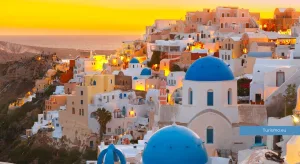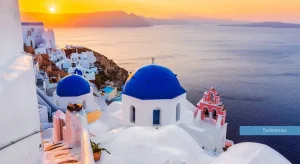
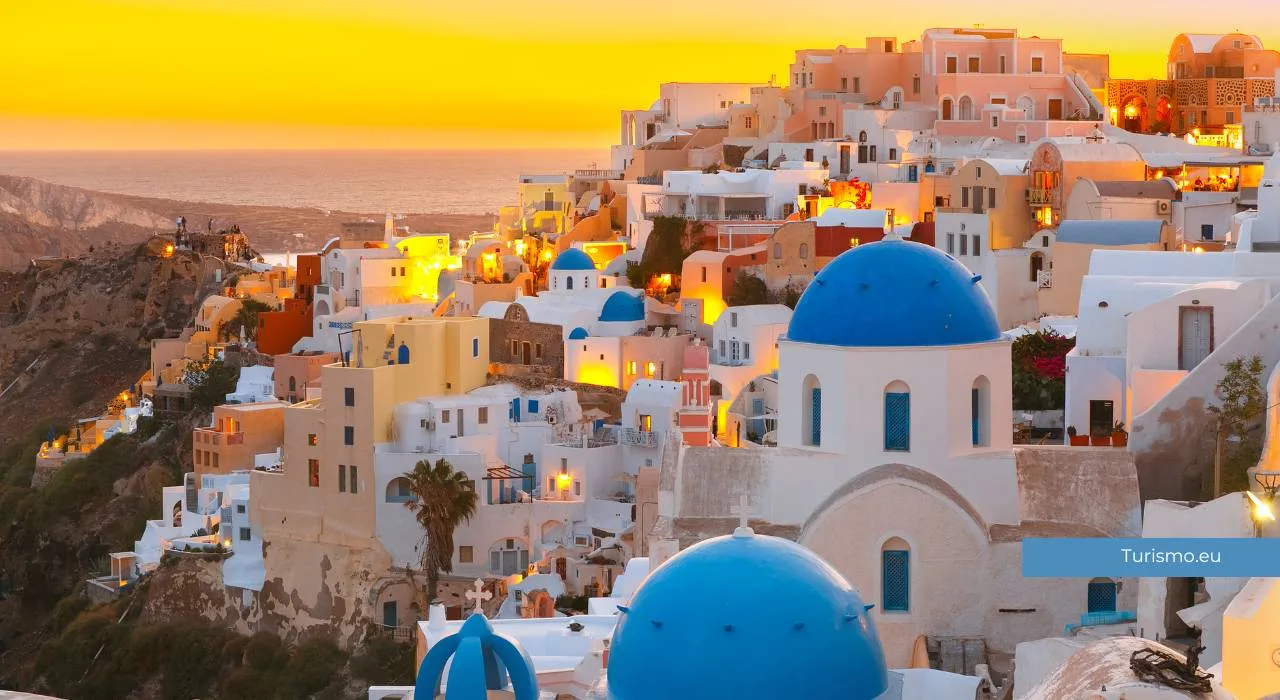
For many first-time visitors, Greece starts as a single iconic image: whitewashed houses stacked above cobalt blue water, blue church domes catching the Mediterranean sun, and a deep volcanic caldera dropping away below the cliffs. That image is Santorini and it still earns the top spot on an inaugural trip to Greece.
Also known by its ancient name, Thira, Santorini sits in the southern Cyclades, right in the heart of the Aegean Sea. For many travelers, it serves as the easiest and most captivating gateway into island life. It is small enough to navigate during a short stay, yet layered enough to easily fill a week, offering unforgettable sunset views, traditional villages, Bronze Age history, black-sand beaches, and exceptional wine grown straight out of volcanic soil.
A simple start to Greek island travel
Santorini works for first-timers because it’s easy to picture, plan, and pair with other islands. There’s an airport, a ferry port, no shortage of hotels, and clear day-trip routes. You can start in Athens, carry on to Santorini, then bolt on Mykonos, Naxos, Paros, Crete, or another Cycladic stop.
While traditional ferries remain the most popular way to navigate the Aegean, travelers with limited time who want to bypass long sea transits can also look into Santorini island hopping via helicopter as a much faster, scenic alternative for a multi-island itinerary.
The island hands you a strong sense of place the moment you land. Fira, Imerovigli, and Oia line the caldera rim. Kamari, Perissa, and Perivolos sit down on the black sand. Pyrgos and Megalochori show the softer village side.
Santorini also works well as part of a wider itinerary through the Cyclades, making it easy to combine with islands such as Naxos, Paros or Mykonos.
The caldera gives the trip a clear center
The caldera is the big reason Santorini feels different from most Greek islands. It’s a sea-filled volcanic basin, carved out by enormous eruptions over the centuries. Stand on the rim and the view tumbles from whitewashed houses down to dark cliffs, blue water, and the volcanic islets of Nea Kameni and Palea Kameni.
You don’t need a complicated plan. A walk along the rim, a sunset dinner, or a boat ride can explain the whole island in a day. The caldera keeps navigation simple, too. Caldera hotels are the ones for views and romance, while east-coast stays give you sand, swimming, and lower prices.
Fira and Oia keep plans easy
Fira is the capital and the main transport hub, with the shops, restaurants, museums, bus links, and caldera views. Oia, up on the north tip, is the sunset one, all blue domes, narrow lanes, and cave-style homes. Imerovigli sits between the two and usually runs quieter, with those wide views from Skaros Rock.
The Fira to Oia walk is the best land-based thing to do here. It rolls through Firostefani and Imerovigli, then hugs the caldera edge to Oia. In the hot months, most people walk just a stretch of it. Come in spring or autumn and the full route feels a lot kinder.
While Fira and Oia are the island’s most visited villages, travellers looking for a quieter atmosphere often enjoy exploring inland villages such as Pyrgos and Megalochori.
Ancient Akrotiri adds real depth
Santorini isn’t only a photo backdrop. Akrotiri, down near the south of the island, is one of the most important prehistoric sites in the Aegean. The settlement was thriving long before classical Greece, and when volcanic material buried it in the seventeenth century BC, that same ash preserved the buildings, streets, pottery, and wall art.
Akrotiri and Santorini suddenly connect to the wider Aegean story. It pairs nicely with Red Beach, the Akrotiri lighthouse, and the little coves along the south coast.
Volcanic beaches add another side
Santorini isn’t the island for soft golden sand, and knowing that up front sets better expectations. The beaches here are volcanic, bold, and unusual. Kamari has black pebbles, a row of beach bars, and a long seafront. Perissa and Perivolos run together into a wide black-sand stretch with plenty of places to eat right by the water.
Red Beach, near Akrotiri, is the one with rust-colored cliffs and dark stones underfoot. Watch the safety signs, since rock falls do happen. White Beach and Mesa Pigadia add more south-coast variety, usually reached by boat or coastal road. Pack water shoes for the hot stones and pebbles.
Wine villages show local culture
Santorini wine is a huge part of the island’s story. The star grape is Assyrtiko, a crisp dry white tied to Santorini and its volcanic soil. The vines get trained low to the ground in tight basket shapes, which shields the grapes from wind and harsh sun.
Pyrgos, Megalochori, and the villages near the inland vineyards are perfect for a slow afternoon. Many wineries pour tastings with caldera or vineyard views, which balances a trip that would otherwise live only in Oia and Fira. And the food follows the land: tomato fritters, white eggplant, capers, fresh fish, and fava made from yellow split peas all give the meals a clear island flavor.
First-timers get many trip styles in one island
Santorini suits couples, families, solo travellers, and small groups because every area plays a different role. Oia is for the classic photos and sunset stays. Imerovigli is for quiet caldera hotels. Fira puts transport, dining, and nightlife on your doorstep. Kamari and Perissa are the beach-and-better-value picks.
That range matters. A new visitor might not know yet whether they’re after boat days, museums, beaches, food, or village walks, and Santorini lets you sample all of it. Three nights can cover the caldera, Oia, Akrotiri, a beach, and a wine tasting. Give it five and you can add a volcano boat trip, a few more villages, and time over on Thirasia.
When to visit Santorini for the best balance
Santorini is open year-round, but for most first-time travellers the sweet spot lands in late April, May, early June, September, and October. Those months tend to bring warm days, good walking weather, and thinner crowds. Summer serves up the hottest beach weather, but the prices climb and the sunset spots fill fast.
July and August are the busiest months, especially when several cruise ships arrive on the same day. Visiting in spring or early autumn often offers a more relaxed experience, while still enjoying excellent weather.
Winter and early spring are quiet. Some hotels and restaurants shut, and ferry plans get more limited. Even so, it suits anyone who values calm streets, lower rates, and easy photography. For a classic first trip, though, shoulder season is the one, with good weather, open services, and room to breathe.
How long to stay on Santorini
3 nights is a solid minimum for first-time Greece travelers. That’s enough for the arrival, a caldera walk, sunset in Oia or Imerovigli, Akrotiri, a beach, and one unhurried dinner. 2 nights can work, but it usually turns the trip into a checklist.
4 or 5 nights feel better if you actually want to rest. That pace gives you a boat day, a village day, and a beach day, with slack left over for wind, ferry changes, or heat. Santorini rewards the people who build in quiet time, because the best moments tend to arrive over a slow breakfast with a view.
Why Santorini remains a popular first choice
Other Greek islands can claim greener hills, bigger beaches, or quieter towns. Naxos has great food and long sandy shores. Paros has pretty ports and easy movement. Crete has a deep history and the wide landscapes.
Santorini remains one of the most popular choices for a first trip to Greece thanks to its combination of dramatic scenery, history, local gastronomy and excellent transport connections. At the same time, it can be the perfect starting point for discovering other Greek islands, each with its own character and pace.
The instant visual hit, the strong transport links, the major history, the local wine, the sights, it’s all there in one place. It also drops into almost any route. Pair it with Athens for history, Naxos for beaches, Mykonos for nightlife, or Crete for a longer stay.
Travellers planning a multi-island itinerary and looking for faster transfers can also check Hoper for scheduled inter-island helicopter flights and air connections across the Cyclades.
Smart tips for a smooth Santorini visit
A bit of strategic planning goes a long way here. Choose your accommodation based on the daily experience you want, not just the view. Cliffside caldera hotels offer unmatched romance, but they often involve navigating steep, winding stone staircases every time you leave your room. Beach resorts on the east coast are often a smarter, more accessible choice for travelers with mobility concerns, young children, or heavier luggage.
The Oia sunset is famous, but it’s not the only one. Imerovigli, Firostefani, the Akrotiri lighthouse, and the caldera restaurants can all feel calmer. Early mornings help, too. Oia before breakfast is softer, cooler, and far easier for photos. In the busy months, plan Akrotiri and the beach runs early.
The final reason Santorini still matters
Santorini holds its first-time appeal because it’s simple and layered at the same time. It gives you the postcard scene you came for, then adds a deeper story through volcanoes, ancient streets, local wine, and cliff villages. It can be romantic, cultural, scenic, relaxed, or active, depending entirely on how you plan it.
For anyone planning a first trip to Greece, that balance is hard to beat. Santorini might be famous, but fame isn’t why people remember it. They remember the first sight of the caldera, the warm stone lanes, the dark beaches, the taste of Assyrtiko, and the feeling that the Aegean matched what they’d imagined.