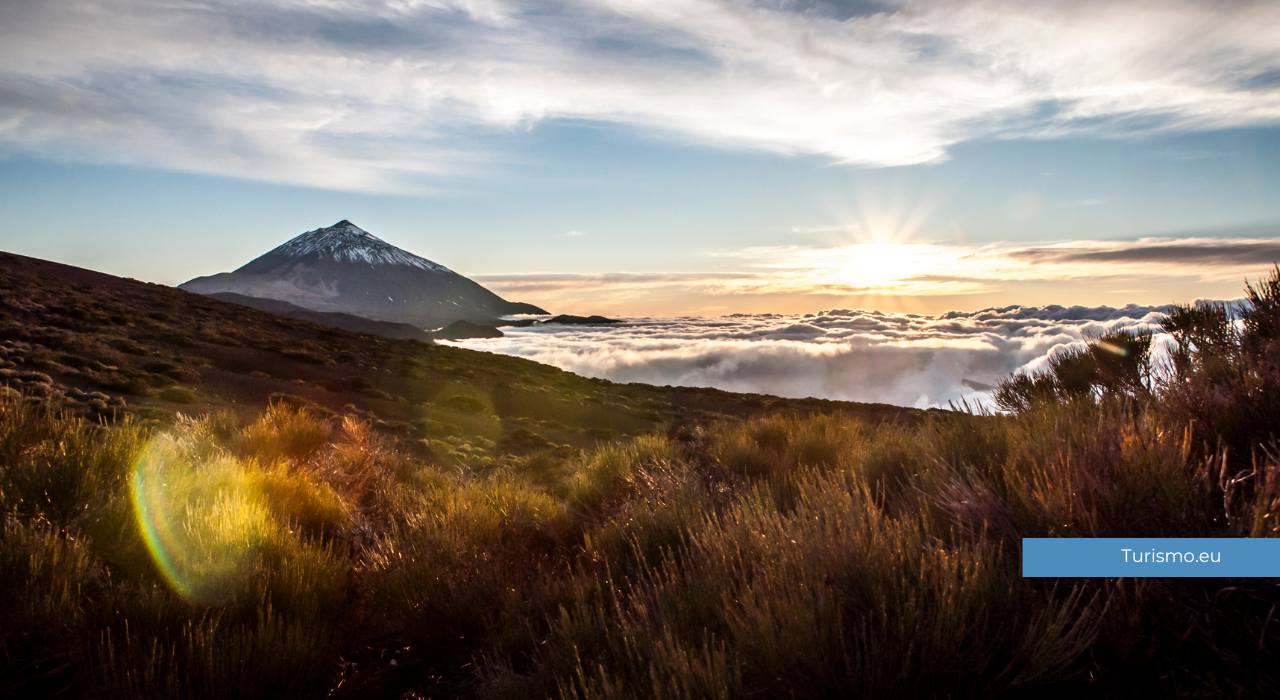


At the heart of Tenerife there is a place that seems to belong to another island, or perhaps to another world entirely. The Parque Nacional del Teide is not only the highest point in Spain, but one of the most unusual environments in the Canary Islands.
Getting there means crossing landscapes that change progressively: from the coast you climb through vegetation, then pine trees, until you reach an arid zone of lava, rocks and open space.
Getting to the Teide: the journey
Reaching the Parque Nacional del Teide is already part of the experience.
The roads that climb towards the park pass through very different landscapes. You first cross greener areas before entering the Canarian pine forests, wide and fragrant, where light filters through the trees in a particular way.
As you gain altitude, the vegetation gradually thins out, giving way to the volcanic landscape.
Along the route there are several merenderos, rest areas equipped with tables and spaces to stop and eat or take a break. They are simple spots, well integrated into the surroundings, and ideal for a picnic.
In some areas there are also regulated camping zones, which allow you to experience the park in a more immersive way.
A landscape you don’t expect
The first thing that strikes you is not the Teide itself, but what surrounds it.
Expanses of lava, rock formations in colours ranging from black to red, and an almost total absence of reference points. It is a wide, essential space where the landscape presents itself without superfluous elements.
The volcano dominates, but it is not the only protagonist.
Climbing the Teide: is it really necessary?
Many people arrive with the idea of reaching the summit, but it is not always essential.
The Teide cable car allows you to ascend quickly, but it depends greatly on weather conditions. Wind can stop it, and even when it is running, the experience varies considerably depending on visibility.
Simply staying within the park already offers some of the most interesting landscapes, without necessarily going all the way to the top.
Walking in the park
One of the best ways to experience the Teide is to stop and walk.
There are simple trails, viewpoints and areas where moving just a few metres from the road completely changes your perspective.
The Roques de García are one of the most striking examples: rock formations shaped by time, which create a strong contrast with the profile of the volcano.
In some areas you will also encounter stretches rich in obsidian, a dark and glossy volcanic rock, fragmented into pieces that reflect the light. Walking alongside it is a striking experience, though it is worth being careful — it can be very sharp.
Altitude and conditions
Even though the Canary Islands have a mild climate, the situation here is different.
The altitude makes itself felt: the air is cooler, the wind can be strong, and the difference in temperature compared to the coast is noticeable.
It is worth having something warmer with you, even on sunny days. In the winter months, it is not unusual to find snow at altitude — a surprising contrast with the climate of the rest of the island.
Practical information
Entry to the park is free, but certain activities are regulated.
The cable car is paid, and to reach the summit on foot from the cable car station a permit with limited access is required.
In recent years there has been discussion of possible restrictions to protect the area, but for now the park remains freely accessible.
A place that stays with you
The Teide is not simply a stop to add to an itinerary.
Beyond the beauty of the landscape, the Teide transmits a very powerful energy. In a space this essential, it is worth pausing for a few minutes, staying in silence, and simply trying to feel it.