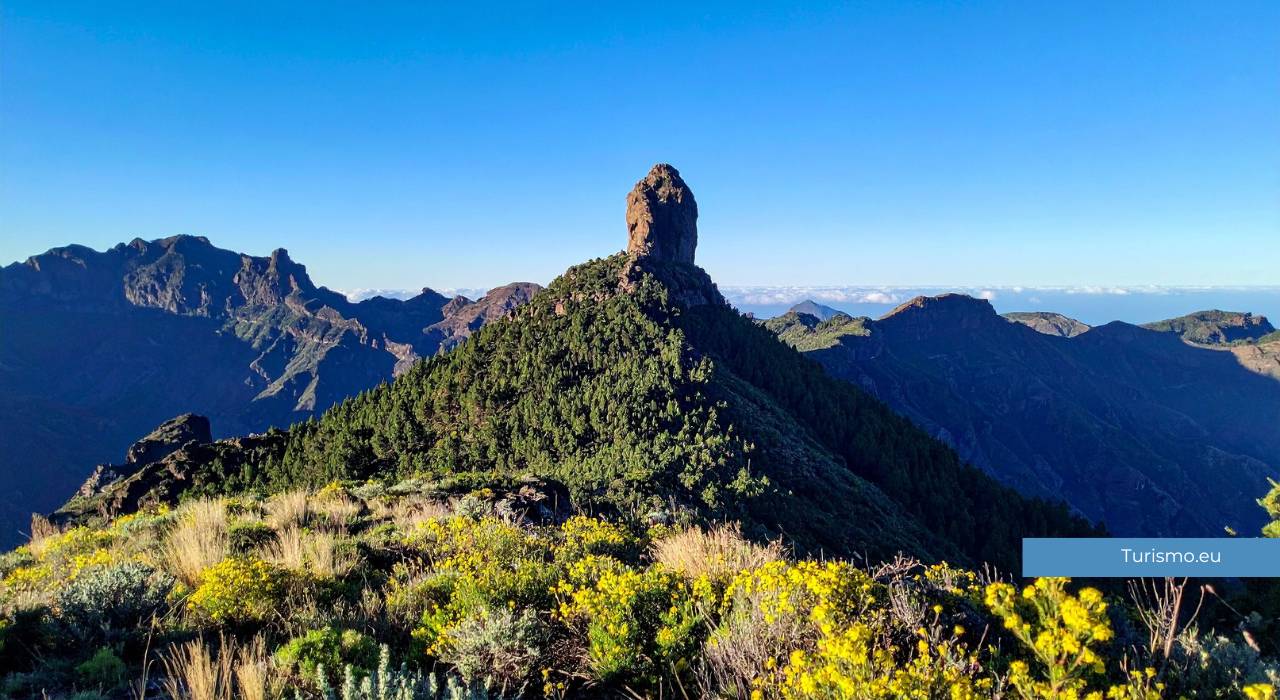


As you approach, the air carries the scent of Canarian pine, broom and sage.
Then you look up and see it: a tower of dark rock rising against the sky, silent and vertical. This is Roque Nublo — the symbol of Gran Canaria, a volcanic monolith that dominates the island from nearly 1,900 metres above sea level.
Those who know Gran Canaria only through its beaches have seen just half the island. The other half is this: a mountainous, wild and little-visited interior, where canyons open up between fragrant pine forests and white villages clinging to the rocks. Roque Nublo is the centre of it all.
A monolith of volcanic origin
Roque Nublo is considered one of the largest natural rocks in the world. It is what remains of the ancient vent of a great volcano, sculpted by millions of years of differential erosion. Geologists have classified it as a special type of volcanic rock, named “Roque Nublo breccia” after the formation itself.
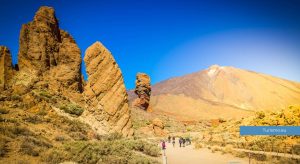
Beside the main monolith, two stone companions complete the plateau landscape: Roque del Fraile — whose silhouette resembles the figure of a friar — and Roque La Rana, smaller and less known, with a small hole that frames the panorama like a natural window onto the island.
A sacred place for the aboriginal people
An ancient place of worship for the Canarian aborigines, the entire surrounding area has been declared a protected natural area and rural park. The relationship between Roque Nublo and the nearby Roque Bentayga is no coincidence: both rocky towers are the main peaks of the Tejeda basin and carry a sacred significance, with the Bentayga worship site located on the slope facing directly towards the Nublo.
Roque Nublo has been and remains a place of pilgrimage for Canarians, a gesture laden with meaning rooted in the deepest collective memory of those who belong to this island culture.
Poets, musicians and painters fell in love with it long before tourists arrived.
The trail: straightforward but spectacular
The standard route starts from the La Goleta viewpoint, on the road between Llanos de la Pez and Ayacata. It is a well-marked path with a steady but manageable ascent to the base of the monolith.
The route is short and suitable even for those with a basic level of fitness. The second half has no shade, so in summer it is better to set off early in the morning or in the late afternoon. The excursion takes around two hours in total, including stops.
Along the way, sunlight filters through the branches of Canarian pines and overhead the silhouette of a kestrel — a small falcon very common in this protected area — is easy to spot. The landscape shifts gradually from dense pine forest to the more open and arid plateau of El Tablón, where Roque Nublo reveals itself in its entirety.
From the base, on clear days you can see as far as the neighbouring island of Tenerife, while mountains, forests and canyons fill the landscape all around.
The Nublo Rural Park
The Nublo Rural Park covers much of the western and central part of the island, spanning over 26,000 hectares of Canarian pine woodland, rocky terrain and the territories of several municipalities including Tejeda, Artenara, San Bartolomé de Tirajana and Mogán.
The park has also been a UNESCO World Biosphere Reserve since 2005. Beyond the Nublo trail, the area offers numerous routes of varying length and difficulty, leading to canyons, pine forests and little-visited panoramic viewpoints.
The village of Tejeda, a few kilometres away, is considered one of the most beautiful villages in all of Spain: white houses, terraced crops, almond trees in bloom in February and a tranquillity that is hard to find anywhere else on the island.
How to get there and practical information
By car — The most convenient option. From the south of the island you head up along the inland roads on a scenic drive of around one hour. From Las Palmas the journey is similar, passing through San Mateo and Tejeda.
Advance booking required — Access to the trail requires online booking through the official website grancanariasenderos.com, where you will find up-to-date information on opening times, car parks and shuttle buses.
Parking and shuttle — Parking near Roque Nublo is not permitted. Car parks are located in Tejeda and at Cruz de los Llanos, connected by a shuttle bus service. Full details on the official website.
What to bring — Plenty of water, hiking boots, sunscreen, a windproof jacket. Mountain weather can change quickly, even in summer.
When to go
The best periods are spring and autumn, with stable weather and fewer crowds. In summer the sun is very intense along the second part of the trail; in winter you can still make the ascent, but expect low temperatures and strong winds.